

Do Small Car Inverters Draw Power When Off
If your introduction to digital electronics came more years ago than you'd care to mention, the chances are you did so with 5V TTL logic. In a higher place 2V but normally pretty close to 5V is a logic one, below 0.8V is a logic 0. If you were a bully reader of electronic text books you might take read about different voltage levels tolerated by 4000 serial CMOS gates, merely the chances are even with them you'd have nonetheless used the familiar 5 volts.
This happy state of never encountering anything but 5V logic as a hobbyist has non persisted. In contempo decades the demands of higher speed and lower power have given united states successive families of lower voltage devices, and we will at present commonly likewise run into 3.3V or even sometimes lower voltage devices. When these different families demand to coexist as for example when interfacing to the electric current ingather of microcontroller boards, care has to exist taken to avoid damage to your silicon. Some means of managing the transition betwixt voltages is required, so nosotros're going to take a look at the world of level shifters, the circuits we use when interfacing these unlike voltage logic families.
Do You Fifty-fifty Need A Level Shifter?
It might seem odd to start a treatise on level shifting this way, but the first question for the designer when looking at making a iii.3V part talk to a 5V part should exist this: Practice I even need a level shifter?
If the 3.3V function is an output and the 5V one an input, the lower voltage part can hardly damage the higher voltage one with overvoltage. And you are not likely to encounter a logic input that might demand then much current that information technology would damage your output (If you do, use a buffer!). If you lot are lucky the logic voltage ranges of the two devices may fifty-fifty coincide. For example 3.3V TTL logic shares the 0.8V and 2V thresholds for logic 0 and logic 1 transitions with 5V TTL logic, so a 3.3V TTL output can drive a 5V TTL input without any extra hardware required.
In the other direction, driving a 3.3V input from a 5V output you might expect that a level shifting excursion would be required, and in many cases you lot would exist right. But before reaching for that shifter information technology's worth taking a wait at the detailed specifications of your three.3V input. Many devices are designed to be 5V tolerant, and you might be lucky plenty to notice that your circuit could use one and avoid the extra circuitry. For example the 74LVC series contains a range of 5V tolerant three.3V versions of many 74-series ICs.
CMOS And TTL: A Level Shifting Cautionary Tale
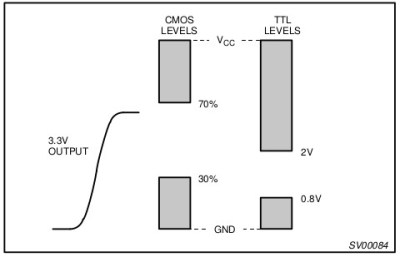
When directly driving logic you lot'd normally utilise at 5V from a 3.3V output at that place is ane cautionary tale of which to take heed, a personal confession of an electronic failure. CMOS logic defines its logic thresholds as a percent of supply voltage, which with a 5V supply puts the logic ane threshold of seventy% well above the 3.3V logic 1. Some CMOS ICs such as the 74HC4053 analogue switch I used in a Raspberry Pi projection don't quite follow this standard and volition piece of work from a 3.3V TTL output, so I was lulled into a false sense of security and reached for another 74HC part to connect to my Raspberry Pi with a new design. Equally you might expect information technology failed to work, and of course I wasted time looking everywhere else but my defective choice of part. If there is a moral to this story it is to always read the datasheet advisedly, and use the TTL-compatible parts such equally in this case 74HCT, when they are bachelor.
If your 3.3V device inputs are not 5V tolerant and your 5V inputs lack 3.3V compatible thresholds then sadly you won't exist able to interface them across voltage levels without a shifter excursion. There are many choices available to you including a whole host of dedicated level shifter devices such equally these ones from TI, only aside from personal preference some of them volition be dictated past your application. Will it be a stride-upward, a step-down, or do yous demand a bi-directional level shifter? If you decide non to use a defended part or a 5V tolerant gate in your design, here are a few of the many alternatives.
Step-down level shifters
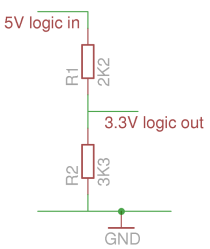
The simplest possible step-downwards circuit is a resistive divider. Drive your 5V output into a chain of resistors, from which you tap your 3.3V logic input. A concatenation consisting of a 2.2k and a iii.3k resistor should produce a 3V output from an practical 5V input. Information technology does not preserve the fan-out feature of the 3.3V output and you lot need to be aware of whatever capacitances that may also reside in any logic is connected to it and the event they may take along with the resistors on fast rise times, only it should suffice for almost simple level downshifting tasks facing a hobbyist. There are variations on this circuit that utilise diodes instead of a resistor to achieve the required voltage drop.
If the divider is not suitable for your awarding and you however eschew a dedicated shifter, have a look further down the page at bidirectional shifters.
Step-upwards level shifters
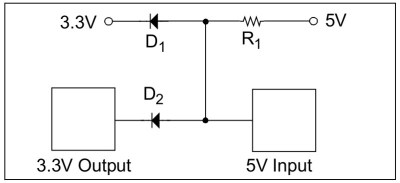
For stepping upward from three.3V logic to 5V logic and assuming you lot are not safely inside the TTL thresholds as described above such that you can do without a shifter, you will crave something a fiddling more complex than the resistive divider in the previous department. The simplest circuit uses a pair of diodes with careful biasing and pick of series resistor equally shown in the diagram to the right. The application annotation it comes from advises that the resistor should be significantly less than the input impedance of the 5V gate, to avoid its beingness part of a resistive divider with that impedance having an effect on the output voltage.
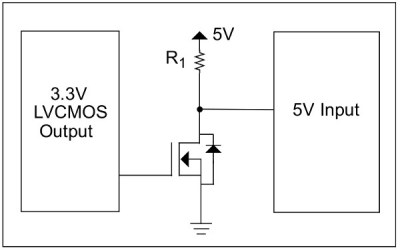
A rather more obvious circuit uses a MOSFET or bipolar transistor as a switch, driving the gate or base with the three.3V logic and taking the 5V logic output from the drain or collector. This is very similar to using a gate with an open-collector output in the same awarding. This is a simple and reliable excursion, but it must be borne in mind that it inverts the 3.3V logic level.
Bi-directional level shifters
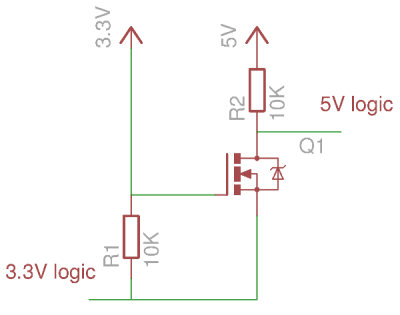
The circuits in the previous two sections are both only suitable for unidirectional logic lines, but non in the instance of a bidirectional bus. As earlier there are enough of off-the-shelf double-decker level shifters from a range of semiconductor manufacturers to choose from, simply if these are not suitable for your design and then a handy alternative can exist made with a MOSFET and a couple of resistors. It's also worth pointing out that this doesn't have to be used on a bidirectional bus, it can serve every bit a general purpose level shifter for the cost of a 2N7000 or similar, indeed this is a personal favourite for this awarding. You tin readily purchase this circuit on a breakout board from several electronics suppliers if building it yourself doesn't appeal. For more information on its operation take a read of the Philips awarding note AN97055 (PDF), which examines its use on an I2C omnibus.
It tin can be a worry, when you offset have to ensure that different logic levels are safely interfaced. Will my 5V Arduino harm this 3.3V sensor? We hope that after reading this slice you lot'll take some more confidence, and we've equipped you with enough to make some sense of the topic. Nosotros've non covered every possible technique, only if you read some of the fastened awarding notes and so search the web for existent-world usage they should fill in any gaps.

Source: https://hackaday.com/2016/12/05/taking-it-to-another-level-making-3-3v-and-5v-logic-communicate-with-level-shifters/
Posted by: carlsonmosion.blogspot.com
0 Response to "Do Small Car Inverters Draw Power When Off"
Post a Comment