

How To Include All Boostrap Template Files In Django Project
Learn How to brand Django Bootstrap iv Template. Django Template System provides a way to separate Python Code and HTML Code. Django is a Pop Spider web Framework. Information technology can exist also used by front end-end frameworks like AngularJS, ReactJS, VueJS. We tin utilize Template Tags and Filters in HTML Lawmaking. It will allow us to use data in HTML.
In this Django bootstrap 4 tutorial, you volition larn how to use HTML Template in Django. Y'all will learn how to change your template path from settings. Here, you'll also learn how to apply static and media content in your template and how to integrate it. You volition also larn how to organize your templates and optimally utilise them without repeating your code.
In this tutorial, we will use our own created Django Admin Bootstrap 4 template theme Example. You can download the template from here. For practice purposes, you tin can employ it and you lot can also use unlike templates of your choice.
We are bold that you have already started your Django project or doing changes in your existing projects. Then allow's get started.
Alter Django Template and Static Paths Directory
Instead of keeping all your template nether the apps binder, I like to create a separate folder and go on all apps template in that.
Create a template binder named templates and a static folder named static at the level of themanage.py file.
Our project layout should look similar this –
. ├── django_shop (settings.py, urls.py, wsgi.py, ...) ├── manage.py ├── media ├── static └── templates
Now that we take created a template and static folder, we need to tell our Django project about that template path and where our static exists. So in yoursettings.py file add the path like this-
TEMPLATES = [ { 'BACKEND': 'django.template.backends.django.DjangoTemplates', 'DIRS': [BASE_DIR + '/templates/',], # <- hither 'APP_DIRS': True, 'OPTIONS': { 'context_processors': [ 'django.template.context_processors.debug', 'django.template.context_processors.asking', 'django.contrib.auth.context_processors.auth', 'django.contrib.messages.context_processors.messages', ], }, }, ] # Static files (CSS, JavaScript, Images) (Y'all tin notice this at cease of file) # https://docs.djangoproject.com/en/2.2/howto/static-files/ STATIC_URL = '/static/' STATICFILES_DIRS = ( bone.path.join(BASE_DIR, 'static'), ) STATIC_ROOT = os.path.join(BASE_DIR, 'staticfiles') Notation – In the template folder, we will keep all HTML files and in static binder CSS, JavaScript, Image. Follow our Django All-time Practice: Configuring Settings File
Integrate Django Bootstrap4 Template
Download our Bootstrap 4 template from GitHub or clone it using bellow command –
git clone https://github.com/studygyaan/Bootstrap-Blog-Template.git
The template structure volition look similar this –
template ├── index.html ├── css └── custom.css ├── js └── custom.js ├── img (images..)
Let's separate our template content, by putting all css, js, image and static content in a static folder which nosotros have created previously. All static content should be put in the static binder.
Your static folder volition await similar this –
static ├── css └── custom.css ├── js └── custom.js ├── img (images..)
Let's motility to our template folder. In your templates binder copy index.html and rename it to base.html.
For loading static content, we demand to load it in our template. Edit your base of operations.html and add the blare lawmaking at the peak above <!DOCTYPE html>.
{% load static %} At present yous take to use static {% static ' ' %} command for loading all images, js, and CSS from the static folder.
Suppose anything is loading from a static binder, for instance, css/custom.css. You need to change href like this –
<link rel="stylesheet" href="css/custom.css">
To
<link rel="stylesheet" href="{% static 'css/custom.css' %}"> Similarly, you have to modify for all tags (script, img, link) href which are loading stuff from the static folder.
<script src="{% static 'js/custom.js' %}"></script> <img src="{% static 'img/Django-Post2.png' %}"> <link rel="icon" href="{% static 'img/favicon.ico' %}"/> <link rel="stylesheet" href="{% static 'css/custom.css' %}"> Note – Content loading from CDN will be untouched.
Let's use a unproblematic TemplateView for loading the template. Edit your urls.py and add the path.
from django.contrib import admin from django.urls import path from django.views.generic import TemplateView urlpatterns = [ path('admin/', admin.site.urls), path('', TemplateView.as_view(template_name='base.html')), ] Your template will look like this –
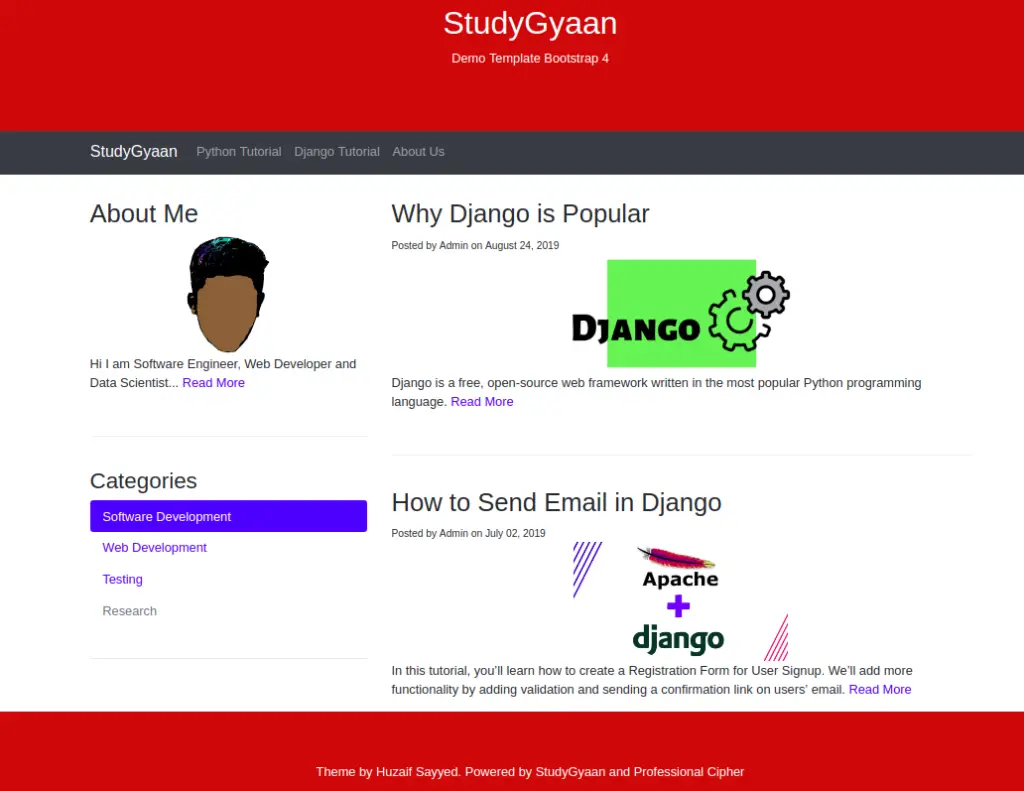
Django Bootstrap 4 Templates sExtending
You can too extend the template usingextends command. This volition aid your template to exist DRY. Let's take an example. Suppose y'all are extending blog.html with base of operations.html.
<!-- base.html --> {% load static %} <!DOCTYPE html> <html lang="en"> <head>Django Template</head> <trunk> {% block content %} {% endblock content %} %} </torso> </html> <!-- blog.html --> {% extends 'base.html' %} {% load static %} {% cake content %} <!-- Your HTML Code --> <h1>Blog</h1> {% endblock content %} # urls.py path('', TemplateView.as_view(template_name='blog.html')), GitHub – Run Example Locally
It is likewise available on GitHub – https://github.com/studygyaan/How-to-Integrate-Bootstrap-4-Template-in-Django
Clone the Repository –
git clone https://github.com/studygyaan/How-to-Integrate-Bootstrap-4-Template-in-Django.git
Change Directory
cd How-to-Integrate-Bootstrap-4-Template-in-Django
Create Virtual Environment – VirtualENV
virtualenv env
Activate Virtual Environment
source env/bin/activate
Run requirement.txt file to install libraries using Pip3
pip3 install -r requirements.txt
Run the server
python3 manage.py runserver
And open up http://localhost:8000/ in your browser.

How To Include All Boostrap Template Files In Django Project,
Source: https://studygyaan.com/django/how-to-integrate-bootstrap-4-template-in-django
Posted by: carlsonmosion.blogspot.com
0 Response to "How To Include All Boostrap Template Files In Django Project"
Post a Comment