

How To Draw A Horseshoe Crab
This post has been originally commissioned for SketchBook Blog in 2022. Afterwards the site'due south migration, the original is no longer available, but you can still access the content here. Savour!
In SketchBook Original: How to Animate Horses I showed yous how to create a equus caballus silhouette with a few uncomplicated lines — plus how to create a moving horse out of them. Today, I'll prove y'all how you can aggrandize your skills to make that simplified horse look existent. You'll acquire advanced beefcake, the coat colors, breeds, and a method to draw the hooves and head. I'll too show you how I drew these horses stride past pace, forth with coloring and shading them in SketchBook.
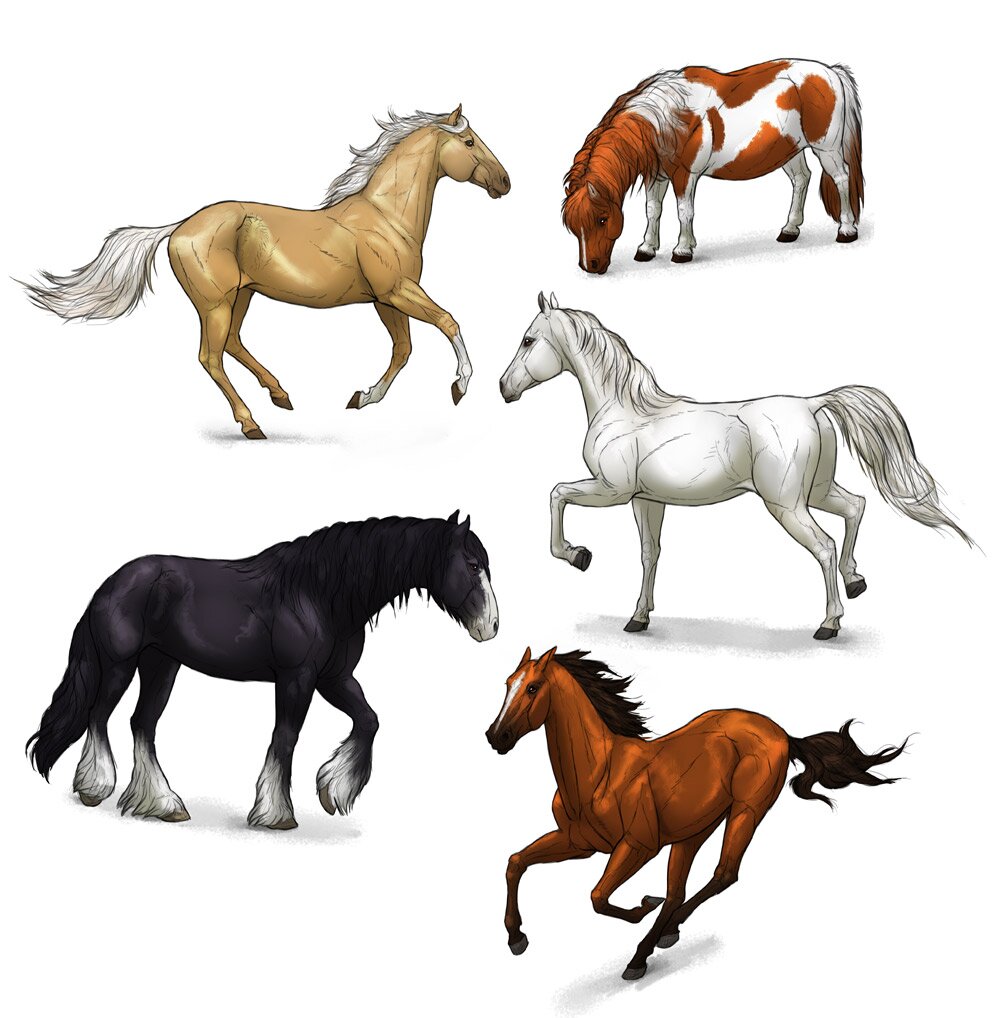
Horse Beefcake
We learned how to depict the basic anatomy in the last tutorial, now it'south fourth dimension to add more detail to it. Brusque hair of the horse makes its muscles very visible, and drawing a horse without them volition make the animate being look fat. You can use the diagram below to draw realistic muscles, but there'south also another way.
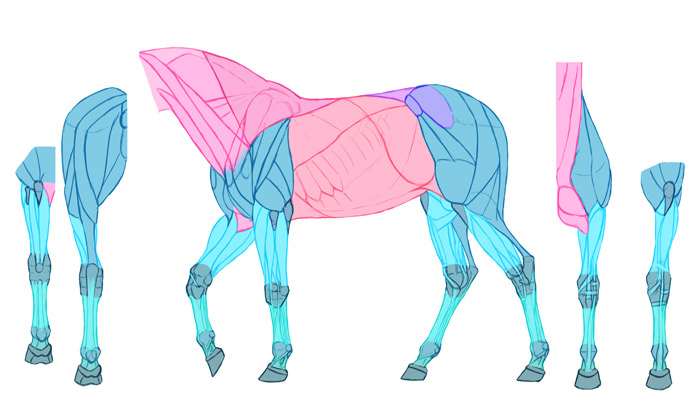
There'due south no need to think all these muscles, because almost of them are non visible near of the fourth dimension. You can use that diagram for a horse in gallop, or for a shiny, muscular horse, merely in near cases you but need to remember these forms. They may look complicated, but requite them a try and you'll meet how each of them immediately tells you lot where to put another i.
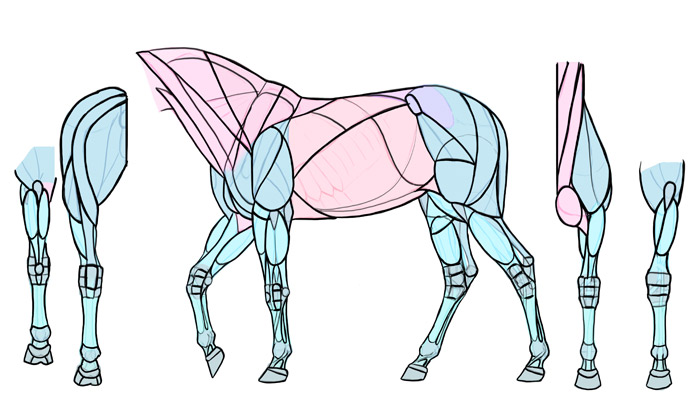
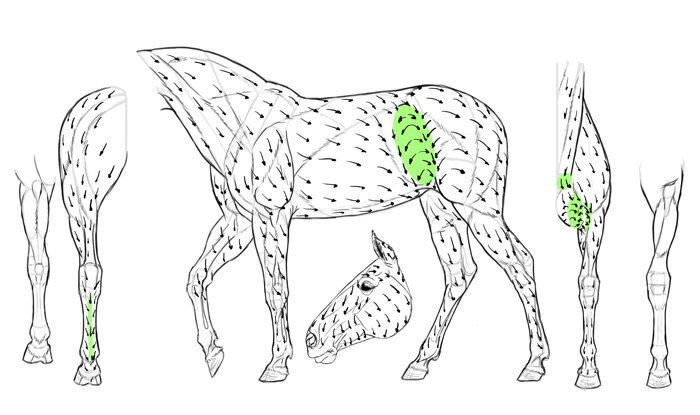
These lines can be then turned into a subtle pattern of fur all over the body:
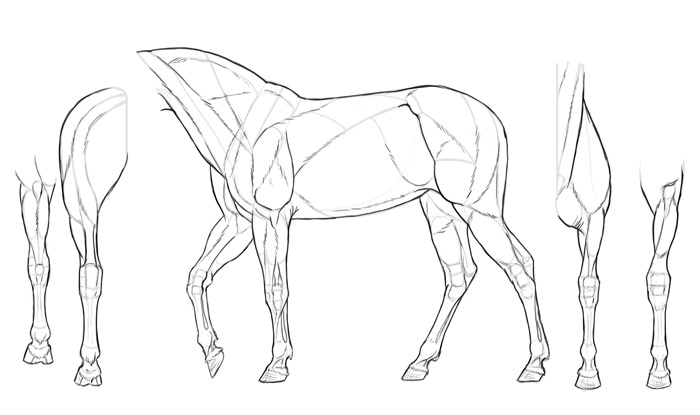
To make it all even more realistic, continue in mind the direction of the hair over the body. Pay special attention to the abrupt alter of direction before the thigh and on the chest.
How to Describe Horse Hooves
You already know how to draw simple horse hooves, just let'south have a closer look at them this time.
Start with a line defining the general position of the "pes." Remember nigh the joints of your finger!
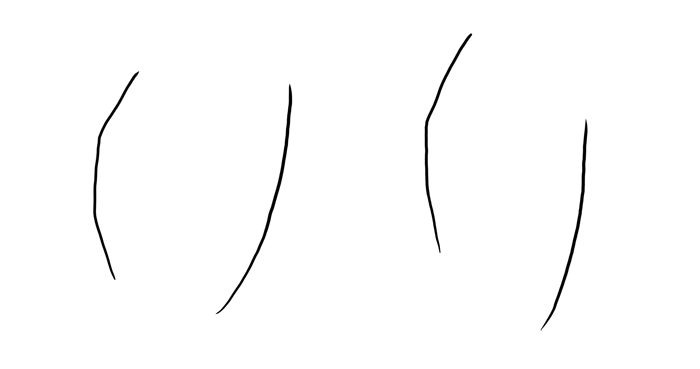
End the line with the length of the hoof.
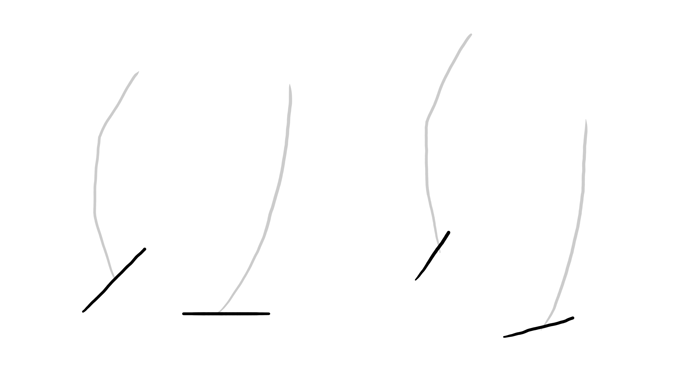
For a 3D position you demand to give the hooves their actual shape. The bottom of a hoof looks like a cut part of an oval. Ovals, or ellipses, can be easily fatigued in perspective with one rule: They're sharp next to the astute angles…
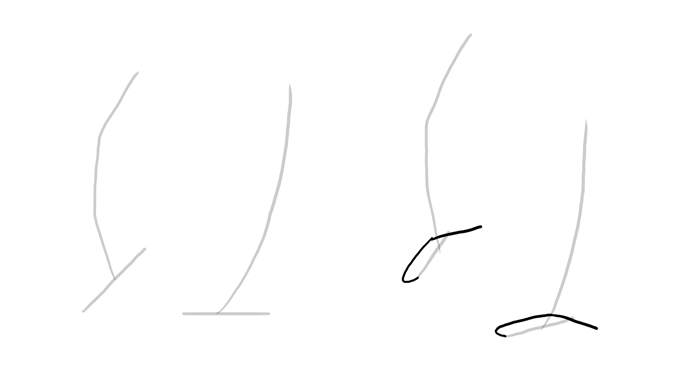
… and apartment next to the obtuse angles.
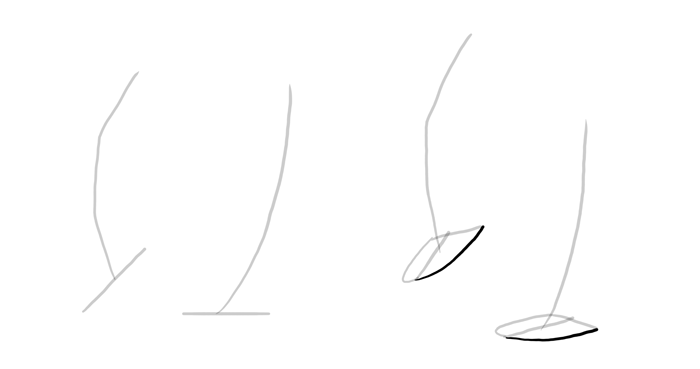
Draw a line above to define the top of the hoof. Be very careful about its position in perspective!
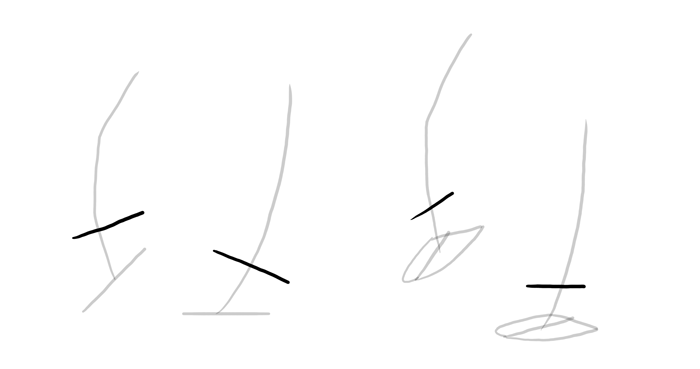
Again, add a shape of a part of an ellipse to the top of the hoof. It's slightly rotated, so this can't be just a re-create of the bottom.
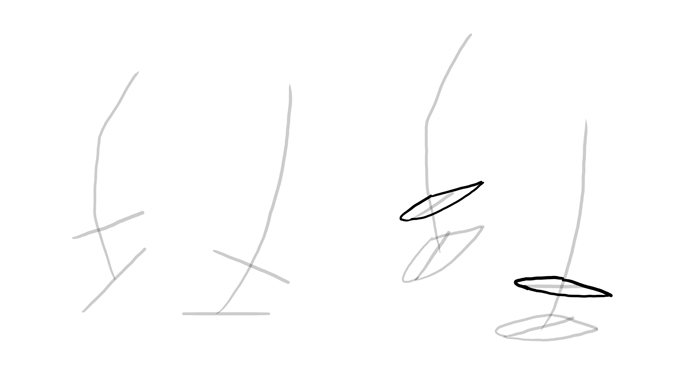
Draw the intersection of the upper part of the "foot." You need to use perspective here likewise, but information technology doesn't need to exist perfect.
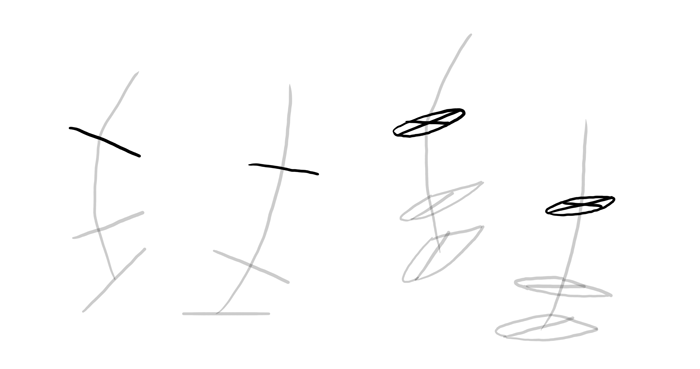
Close the grade of the hoof…
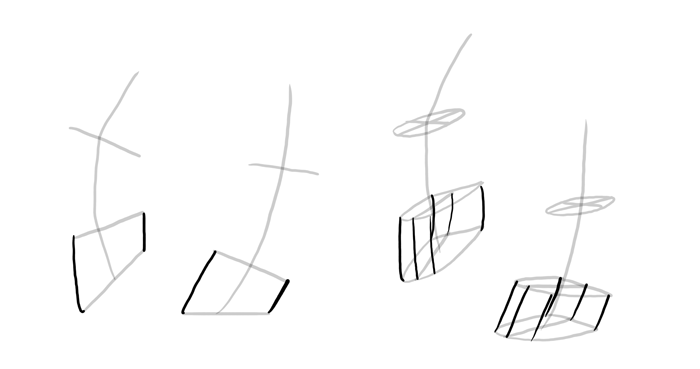
… and of that circular office above.
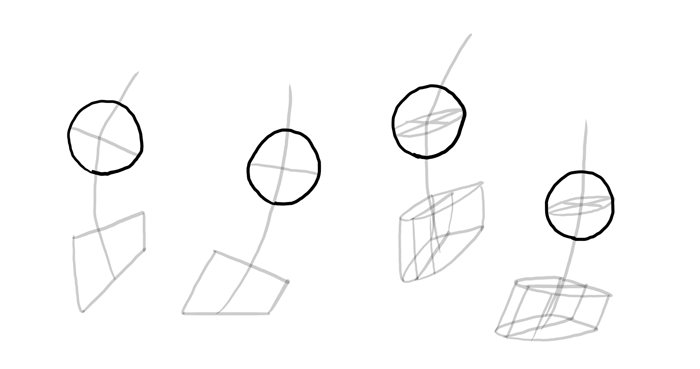
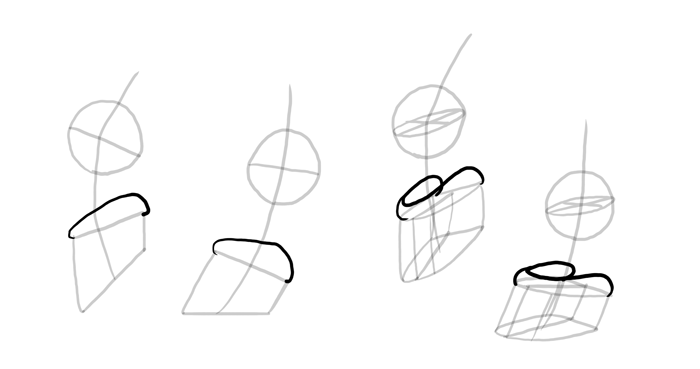
Add the "cap" to the hoof. Observe how it creates two tips behind the hoof—it'southward because the hoof is actually a blast with two edges folded to the back (it'south not a airtight shape).
Finish the outline of each foot. In perspective, remember to accentuate the dissimilarity between sparse bones and the round parts.
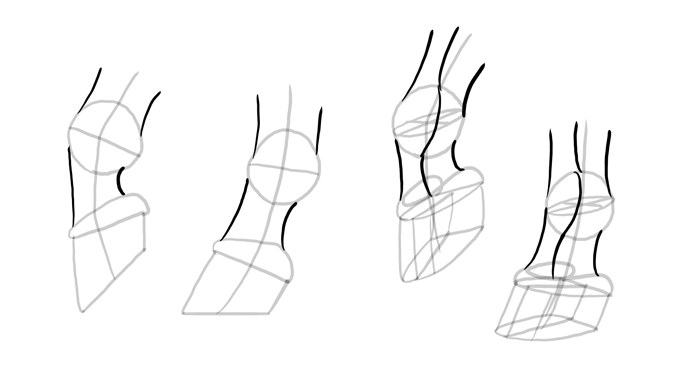
Terminate the cartoon. It doesn't need to be as detailed as this, specially when y'all're not drawing a shut-up.
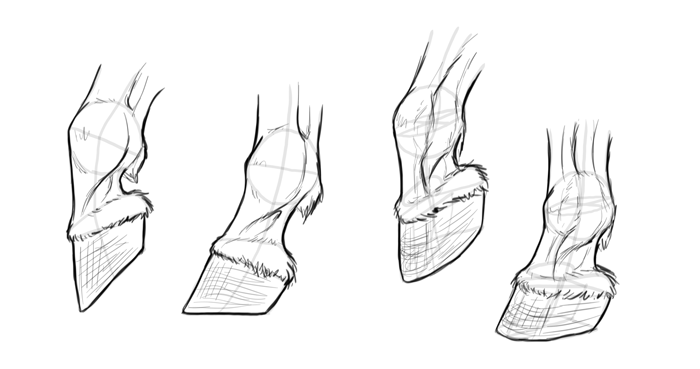
How to Draw a Horse Head
Starting time with a shape of a flattened teardrop. No matter what perspective you employ for this drawing, y'all demand to be able to visualize this class in your head.
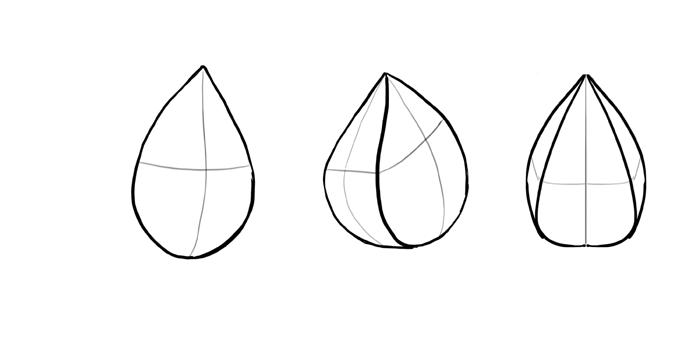
Draw a line to the mouth, and end it with a sphere. The space between both forms should be roughly smaller than the sphere.
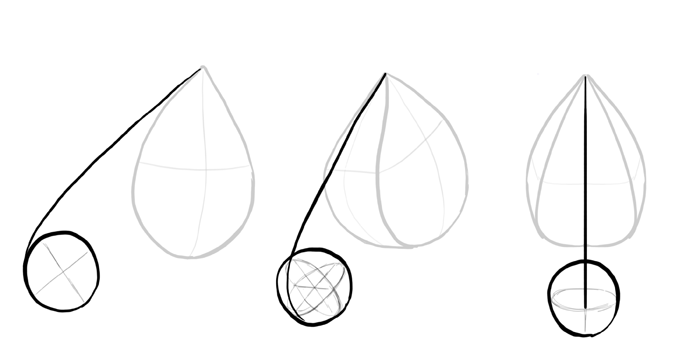
Connect both forms with another line to create the lower part of the caput.
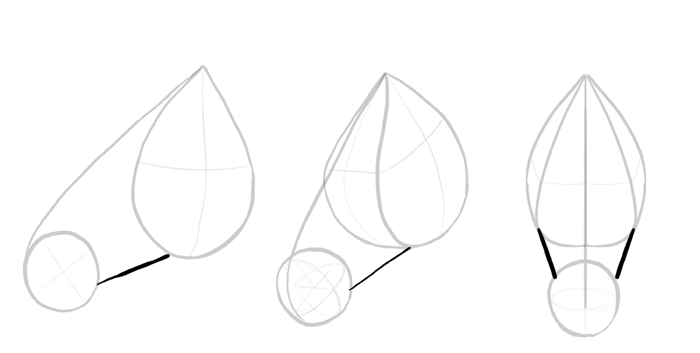
Create the sides of the head with ii lines. This side line should be placed roughly in two-thirds of the head'southward superlative.
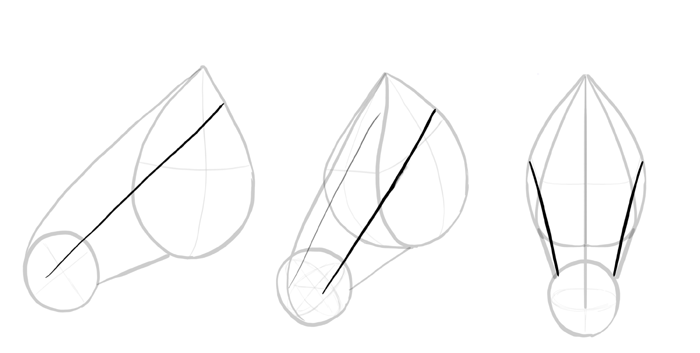
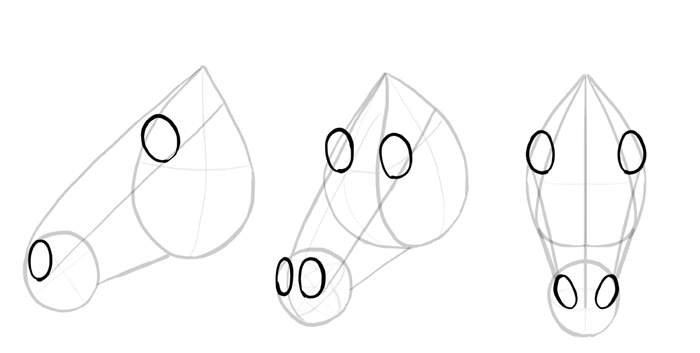
Draw space for the eyes and olfactory organ over these lines.
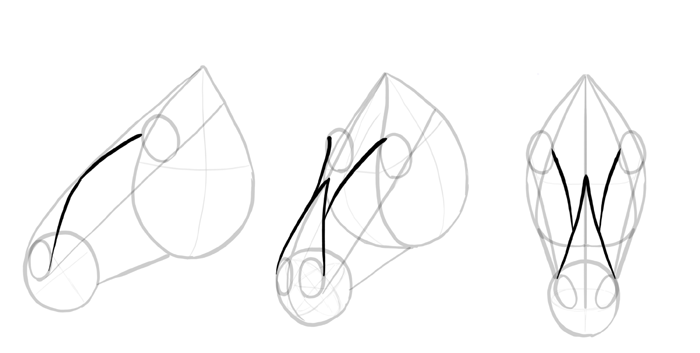
The top of the head is flattened and it has a certain shape. Depict it, connecting eyes and olfactory organ with information technology.
Draw a smaller sphere inside the oral cavity sphere. This will exist the space for the bodily muzzle.
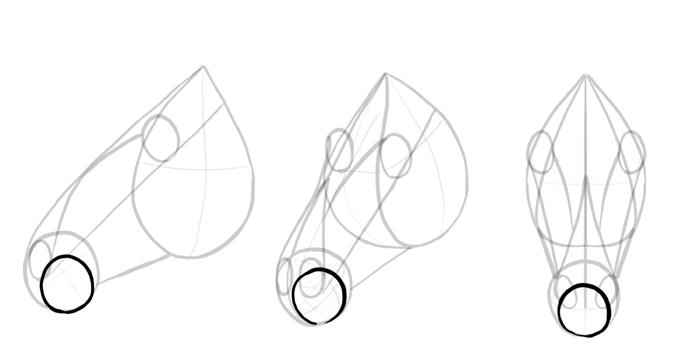
Cut the sphere in thirds and depict the mouth line, finishing information technology with round corners.
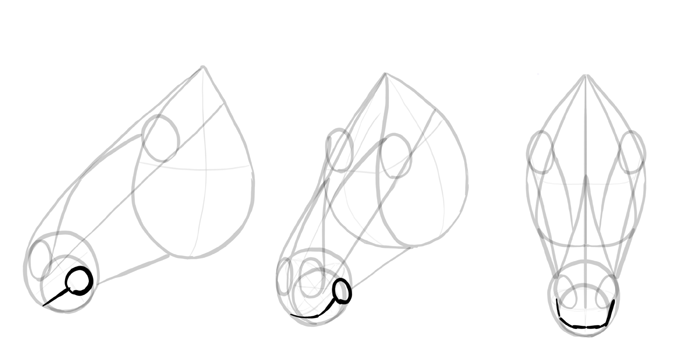
Eyes should be slightly protruding, and then add humps behind them.
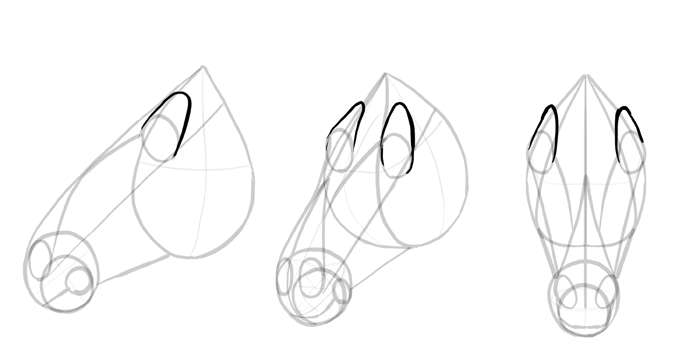
Depict ii spheres on the top of the head to create the space for ears.
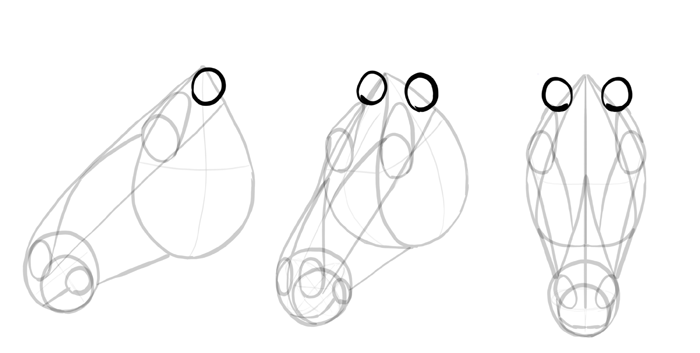
The ears should be shaped like narrow ovals stuck to the spheres.
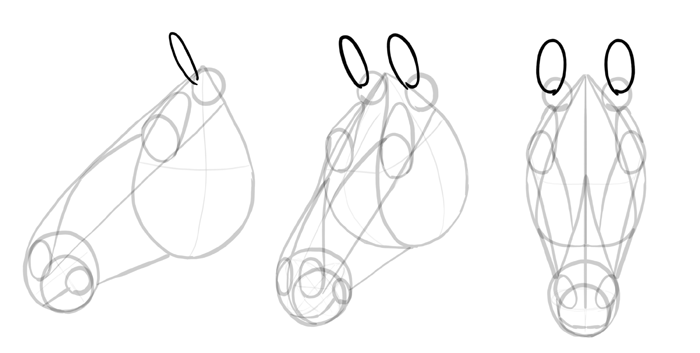
The ears have pointed tips directed towards the center.
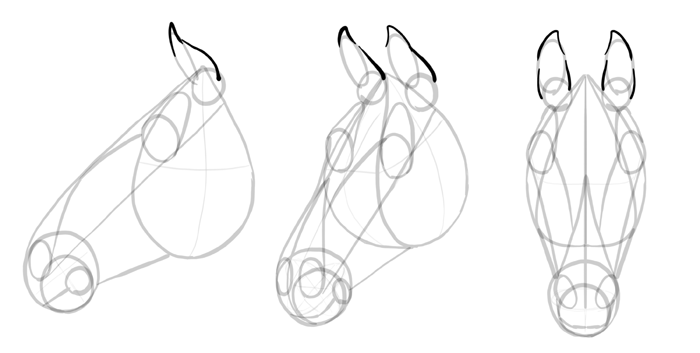
OK, the general shape of the head is done! Let'south draw the details at present, one by one.
How to Draw Horse Muzzle
Outline the mouth with meaty lips. There should be a prominent mentum under them.
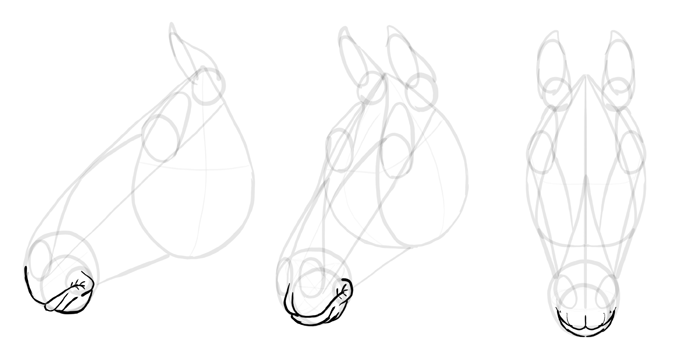
The nose tin can be drawn with one line. This shape tin be narrow when the equus caballus is relaxed, and very round when the horse is running or being angry.
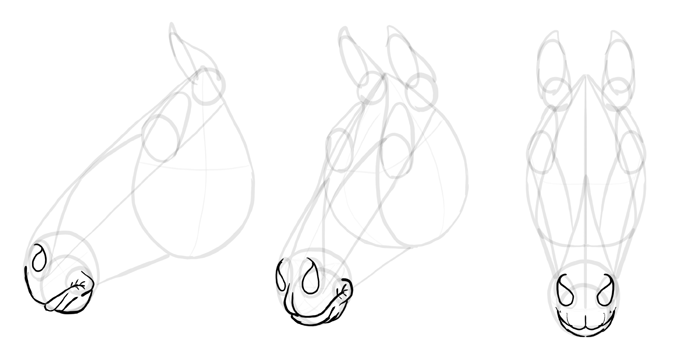
And then yous can add together some fleshy nostrils around.
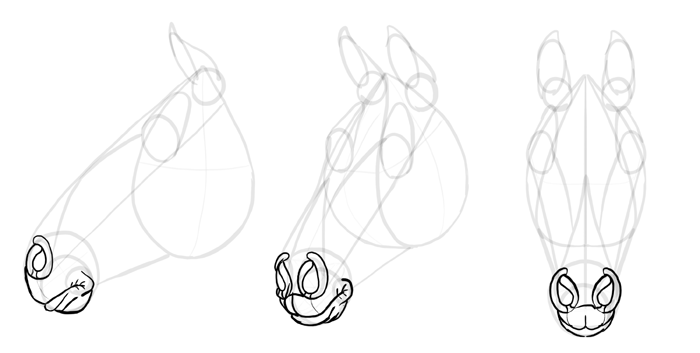
How to Draw Horse Eyes
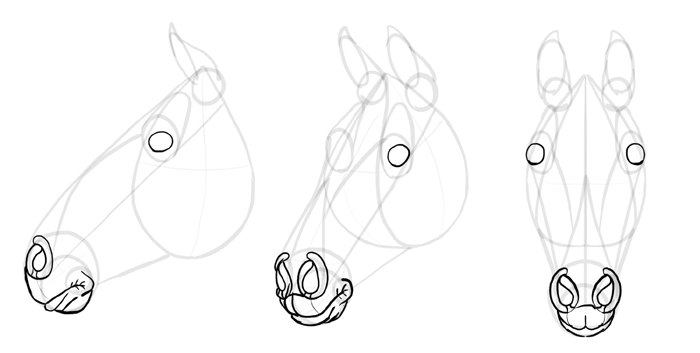
Start with an oval placed quite shut to the brow.
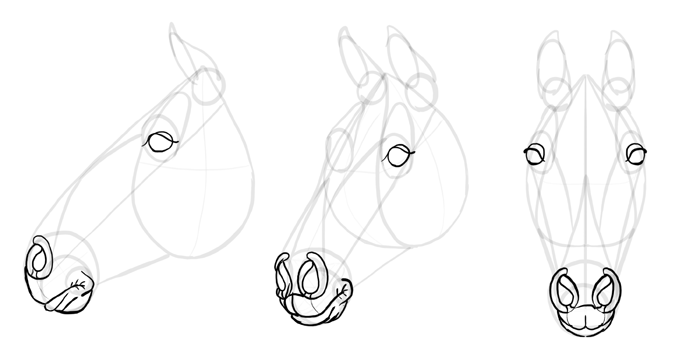
Cover the oval with an eyelid. This shape is very characteristic for a equus caballus.
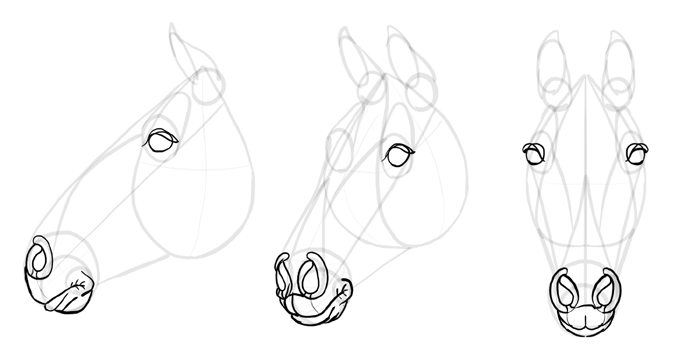
Add together the lower eyelid.
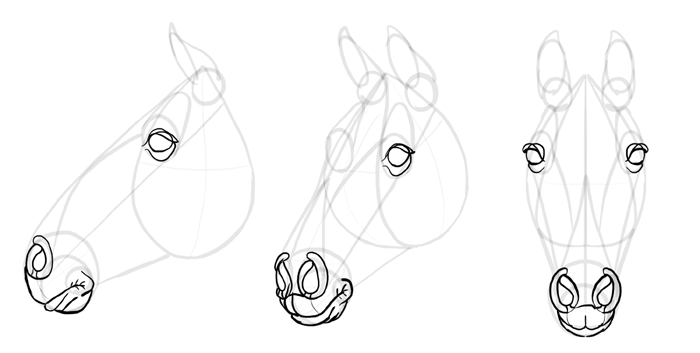
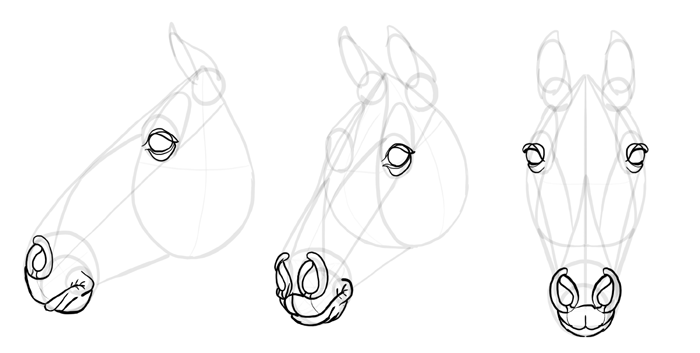
As I mentioned before, the eyes are protruding, then add some class in a higher place them. It should await like excessive skin folded over the middle.
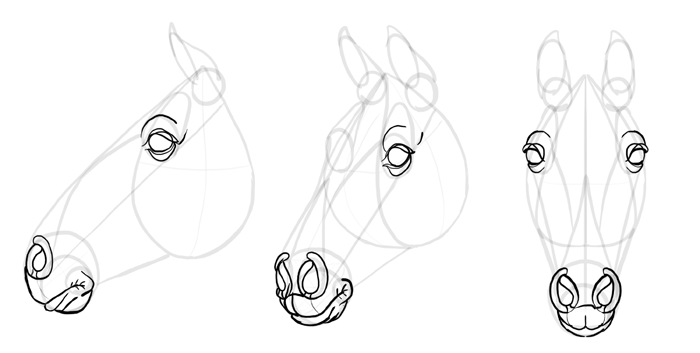
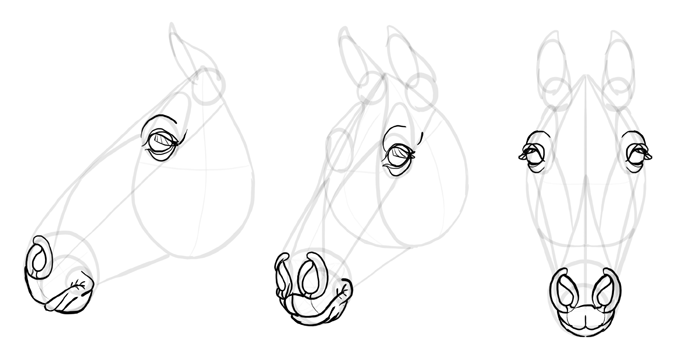
Add the curtains of eyelashes.
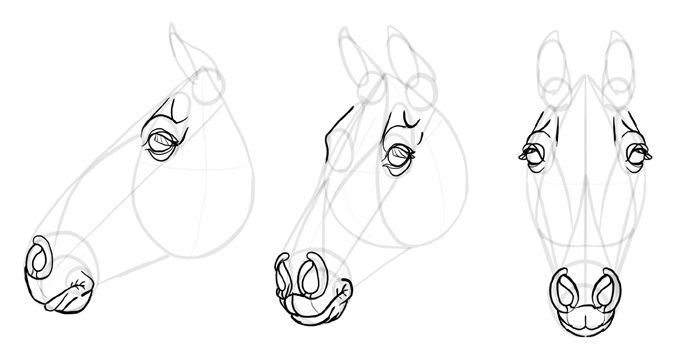
Finish past defining bone construction over the eyes.
How to Draw Horse Ears
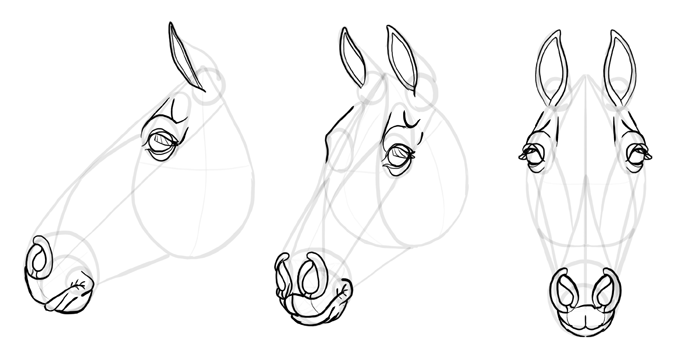
The ears are made of thin skin, but it still has some width. Draw the edge of the ears using this width.
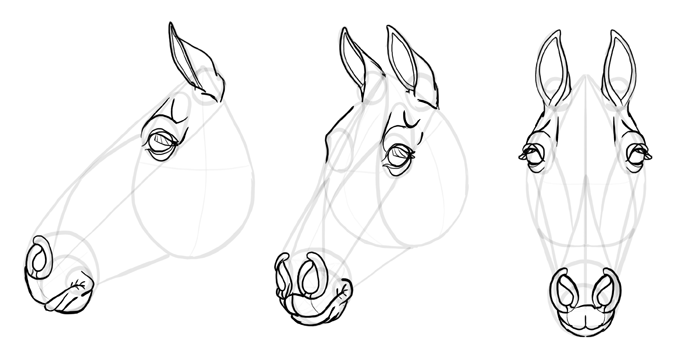
Draw the back of the ears, wrinkling the skin where necessary.
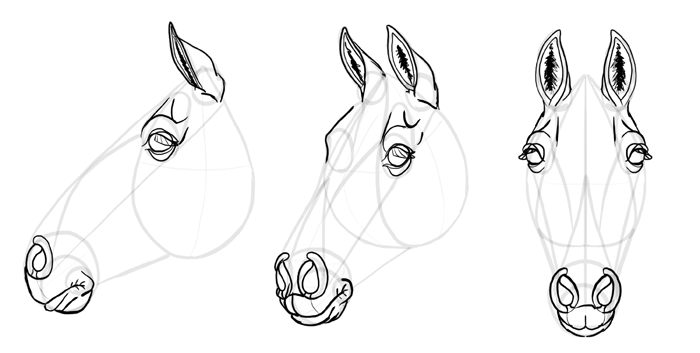
Draw the fur inside the ears.
How to Draw Horse Head Muscles
Y'all can draw a horse head without any muscles, but they make a cartoon more realistic. Let's learn how to simulate some anatomy in a uncomplicated way.
Outline the cheek. There'due south a bony protrusion on top of it, very important for a realistic await.
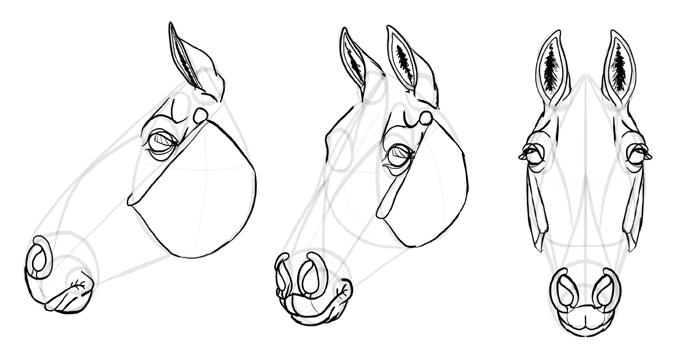
Draw an oval between the cheek and muzzle. It's a complex of various muscles, but it normally looks like one thick musculus and it'southward easier to call back this way.
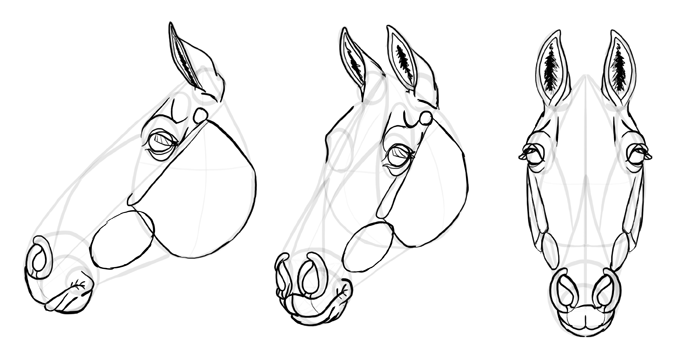
Connect each nostril and the eye with two interconnecting muscles.
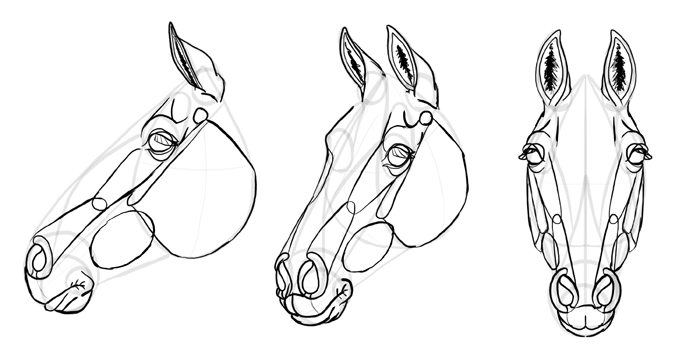
Draw two stretched muscles under that oval in the heart.
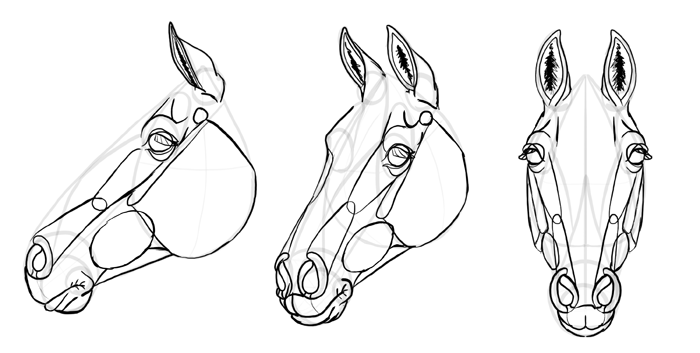
Accentuate the flat brow. In that location'due south no muscles here, so its form should be very articulate.
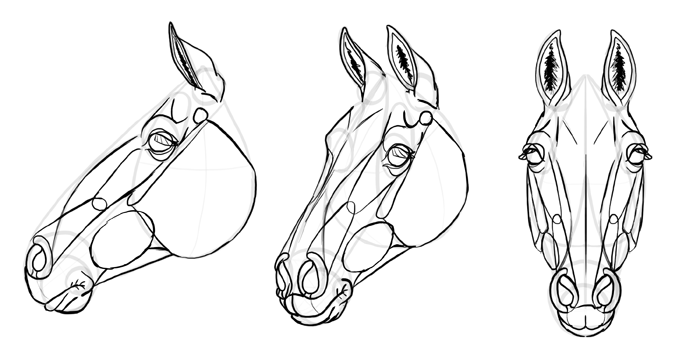
Close the outline of the head.
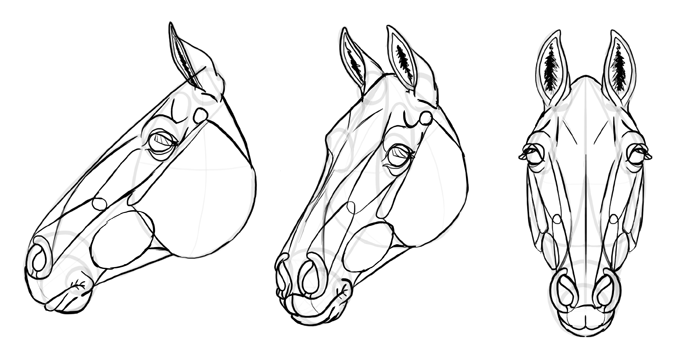
If you want, yous tin add more details to the muscles this way:
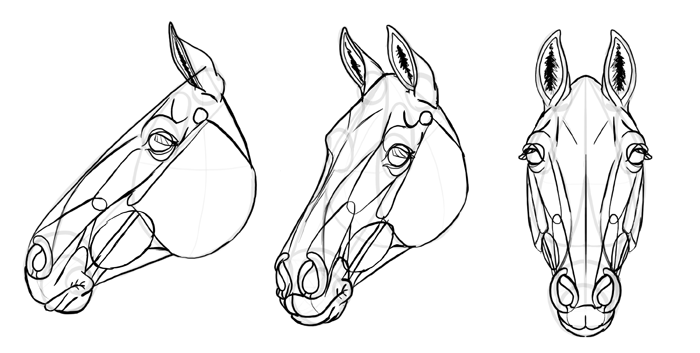
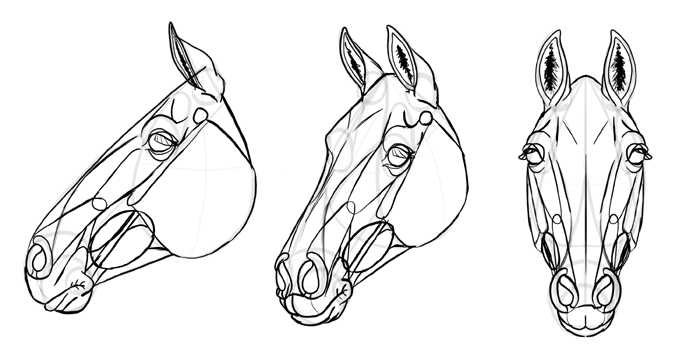
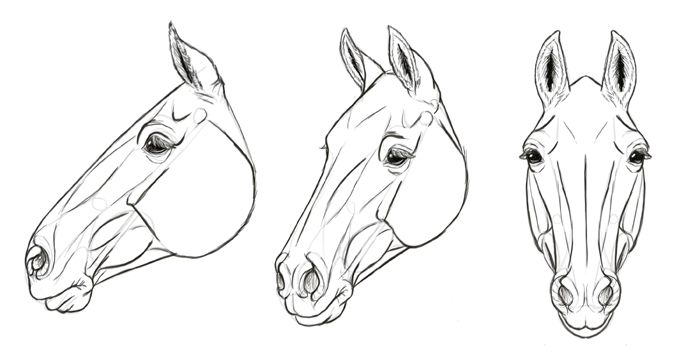
You lot can at present finish the drawing! Keep in mind that horses have a horizontal pupil in their eyes but similar goats. In well-nigh cases it's non visible because the eyes are brown or black, but call back it if you want to requite your horse bluish eyes!
How to Draw a Horse Mane and Tail
Horses are unique non only because of their proportions, but besides because of beautiful mane and hair that's different than hair on the rest of the body. They're non difficult to depict, just you demand to understand how they "work" to create a correct drawing.
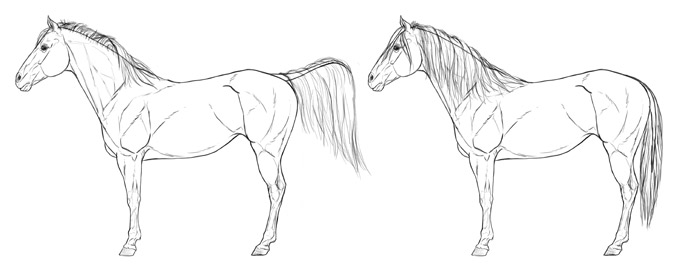
The actual tail is quite short and thin, but there'southward long hair attached to it. It's more similar a broom of loose hair than a furry tail. The mane grows from the middle of the neck, and unremarkably falls on one side of it (or "breaks" to autumn to the other side likewise, creating an effect seen in the kickoff image). Some of the mane hair tin country on the brow.
The length of tail and mane in nature is quite fix for practical reasons: the mane covers function or all the neck, and the tail doesn't come to the ground. Nonetheless, if the horse is specially cared for, the hair can grow far longer than that.
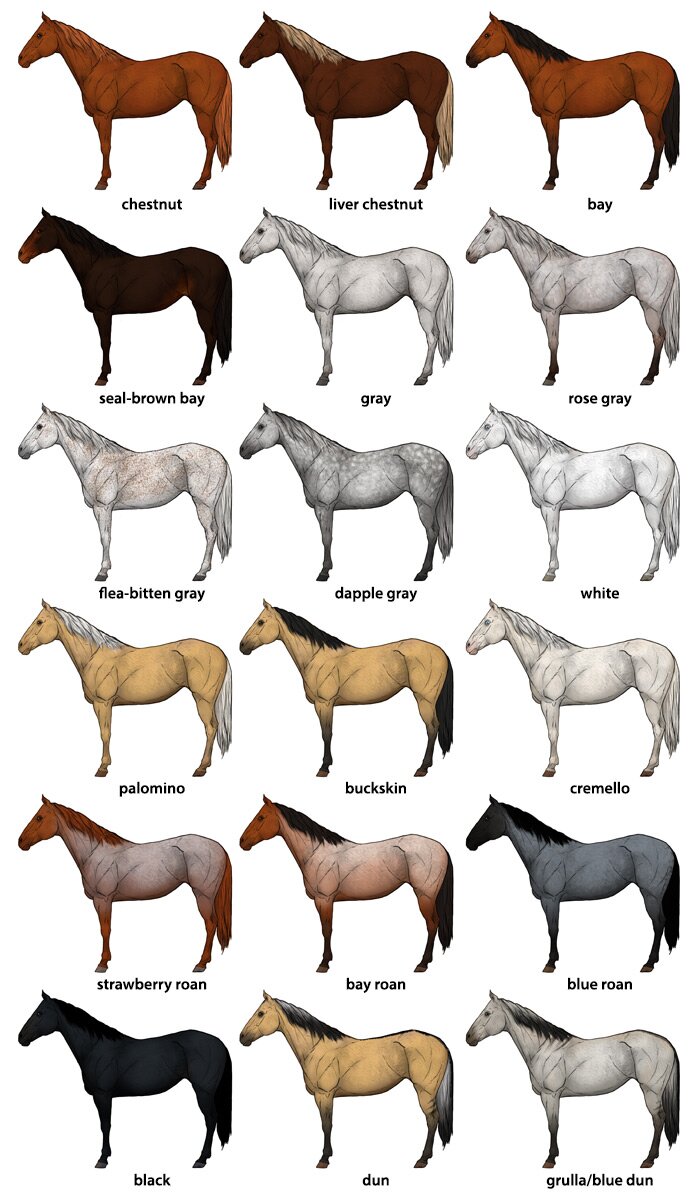
Horse Colors
Horses have very diverse coloration, with a circuitous genetic rules backside all the cute coat colors. In theory, at that place are only two horse colors: black or not black (chocolate-brown). The other ones are created past boosted genes that strengthen, weaken, or mix the bodily base colors. You don't need to become a specialist of genetics to draw a realistic horse; just use this nautical chart for the virtually popular combinations (I'm sorry if I didn't include your favorite one—there's too many!). If you want to know more (or think it better) I'll tell you a few words about each colour:
- Chestnut: a base color, likewise called cherry-red. Chestnut horses have even color over the body, with the mane and tail either the aforementioned color or brighter (chestnut horses with very bright mane band tail are called flaxen). The actual color tin can vary from bright red to very dark chocolate-brown (e.g., liver chestnut).
- Bay: a very popular color for most breeds. It looks similar chestnut with black "points:" lower legs and mane with tail. Bay horses can have various shades of brown, with a special variation chosen seal-dark-brown bay. Such a equus caballus sports a very dark shade of brown, with red showing nether the belly, before the thigh, behind the elbow, and on the muzzle.
- Gray: 1000ray horses are often dislocated with white. They are born with another color, and and then they gray out with age. Since they keep a dark skin from their previous coat, they're never fully white (they often accept a darker muzzle and fur around the eyes, unless their original coat had white markings in those places). Gray horses may look quite differently during their transition into a fully "white" phase. We differentiate, among others, rose gray (a red/brown horse lighted by white hair), flea-bitten gray (almost completely white hair with single red hairs all around the trunk; it can be the terminal stage too), and dapple gray (various shades of gray with spots of white).
- White: Information technology's a rare color, and it happens only if the pare is pink (without pigment). Truly white horses are born white, and they can have blue eyes. White horses are not albino!
- Palomino: It'south a lightened version of chestnut. Palomino horses are golden/blond with mane and tail of the aforementioned color, brighter, or even white.
- Buckskin: Just like palomino, but it happens to genetically bay horses. The main coat becomes lighter, while the points stay dark.
- Cremello: It's a whitened version of palomino (but nevertheless not truly white). Cremello horses often have blue optics.
- Roan: Roan horses have a "normal" color mixed with white pilus on the main body. Nosotros differentiate strawberry roan (chestnut), bay roan (bay), and bluish roan (black).
- Black: Dissimilar from nighttime bay, it's ordinarily tinted with bluish or red (if bleached by sun). Black horses are oftentimes born equally mousy-grey.
- Dun: It'due south thought to be a color of the original wild horses, every bit Przewalski's horses are all dun. Dun horses are tan or mousy-gray (grulla/blue dun), and all of them have a dark stripe coming along their dorsum. They tin as well bear witness primitive markings: dark stripes on the legs and shoulders. The mane and tail can exist frosted with white hair.
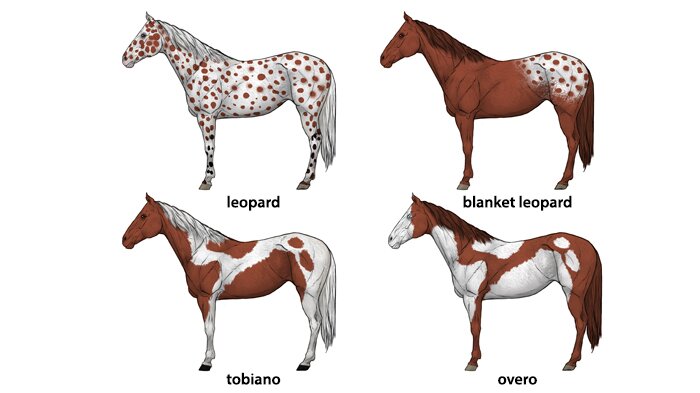
Horses can also accept colors combined in a special design. Tobiano horses with black base are chosen piebald, and the others—skewbald.
Of course, regardless of the color combination, horses can besides have white markings on the torso that make them look unique. The skin under them is normally pinkish.

How to Draw Horse Breeds
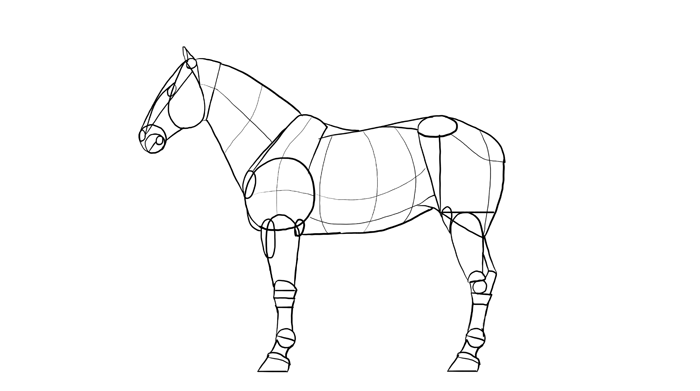
I've shown you how to draw a "general horse," merely horses come up in many shapes. Let's learn how to modify that full general recipe to create a few dissimilar types of a horse. Keep in listen that my diagrams are slightly exaggerated to accentuate the differences between breeds. You need to study the breed using photos, videos, and real horses if you want to create a perfect image.
Quarter Horse
This is "typical horse" number one. Harmoniously built and visibly strong; this is a horse you lot would imagine working on a farm or carrying a knight to state of war. Quarter horses come in almost all available colors.
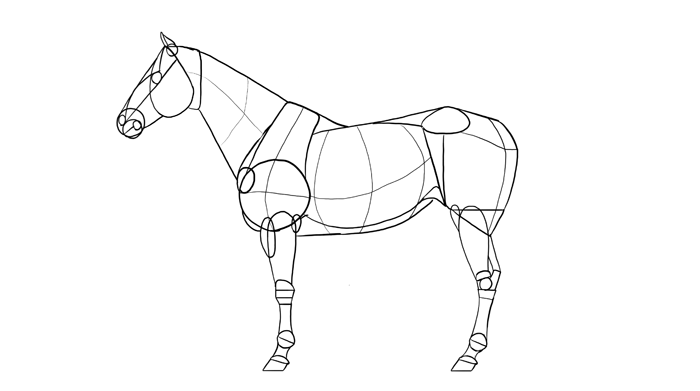
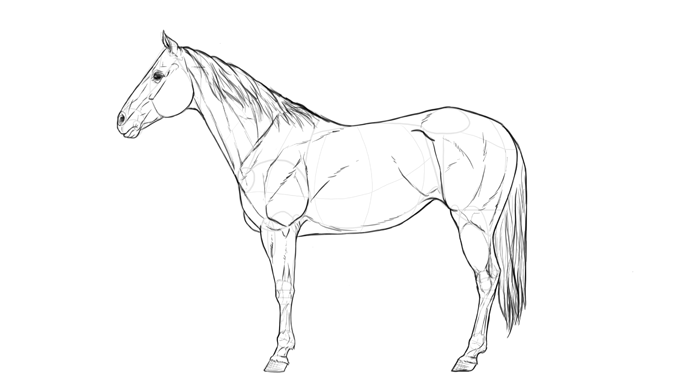
Thoroughbred Horse
This is "typical equus caballus" number ii. You can imagine it as a quarter equus caballus modified for racing—its silhouette is slimmer, with longer legs and sharper cage. Thoroughbred horses are ordinarily chestnut, bay, black, or greyness (roan and palomino tin occur too).
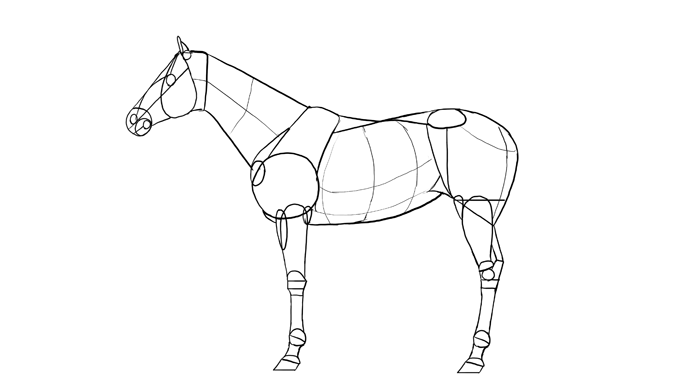
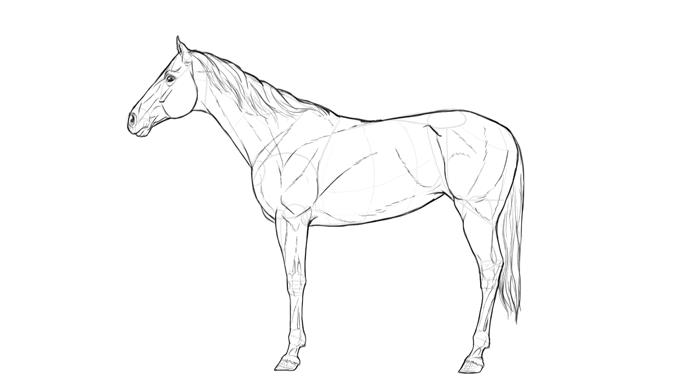
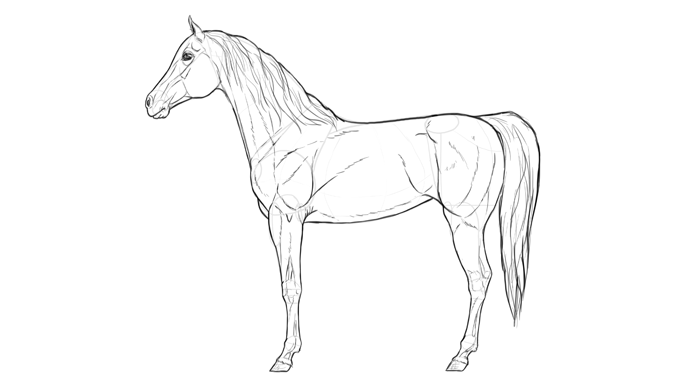
Arabian Horse
These cute horses look like an even slimmer, more elegant version of a thoroughbred equus caballus. They have a characteristic circular brow and large eyes, and keep their tail high, even when relaxed. This makes the rump wait flatter than in other horses. The neck is arched, though it's non visible in every pose. Arabian horses can exist gray, bay, anecdote, roan, or black.
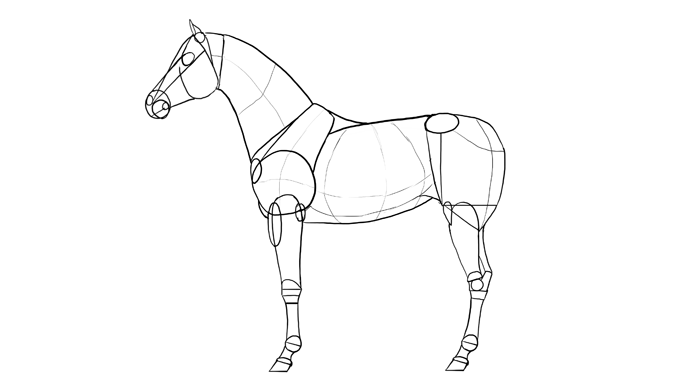
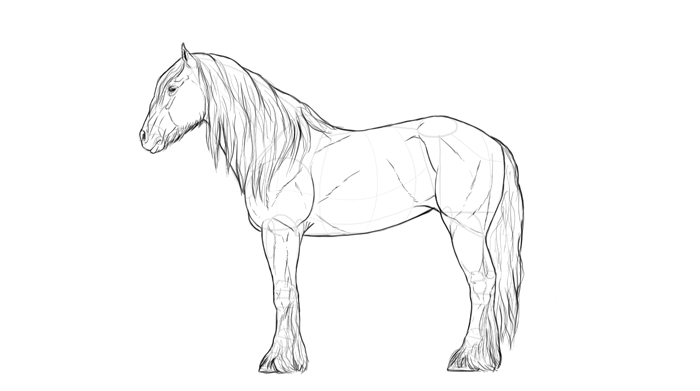
Shire Horse
Shire horses are draft horses, which ways they're bred for heavy work on the farm. They're very strong, which shows through their silhouette. They're big and heavy, and so the hooves are noticeably larger and flatter than in other breeds. The head is huge, with the optics looking small in comparison. Shire horses come in many colors, usually bay, anecdote, gray, black, or roan.
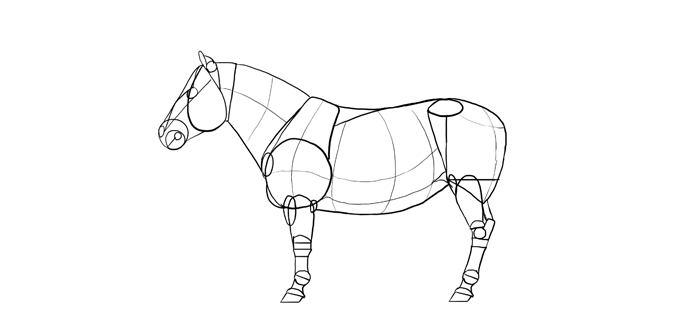
Shetland Pony
Ponies are horses every bit well, just with quite different proportions. Nigh pony breeds take a proportionate body with shorter legs, simply Shetland ponies take this feature to extreme: their legs are often shorter than their torso. If you encompass the legs, you'll see other subtle differences you need to pay attention to. Shetland horses come in all the colors, but are usually anecdote, bay, grey, black, dun, or roan.
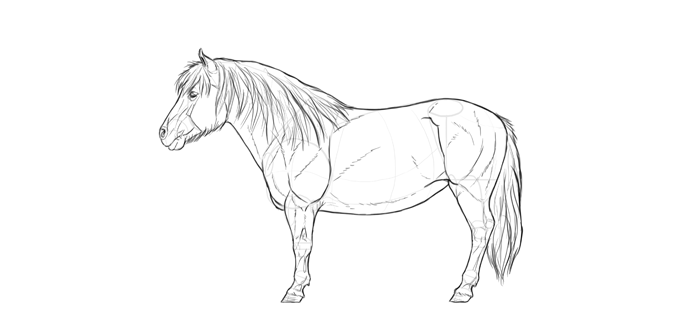
How to Draw a Horse Stride past Footstep
This was so much data! Let's use information technology now in practice. Y'all can draw from imagination, just it's ameliorate if you use a few references and depict them step by step. This way you'll understand the process faster. Don't copy me—analyze what I'm doing and why I'm doing it instead.
Start with the main torso. It's fairly similar in all the breeds, and so yous don't have to utilize whatsoever special measurements hither.
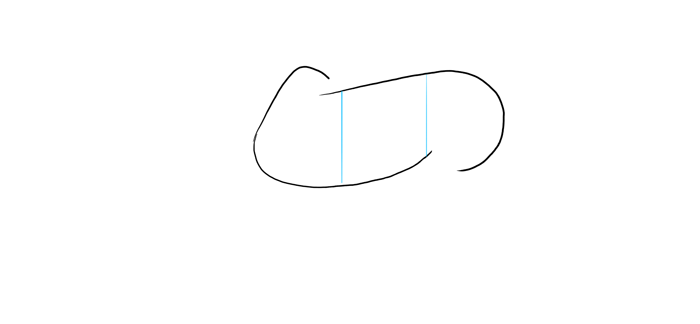
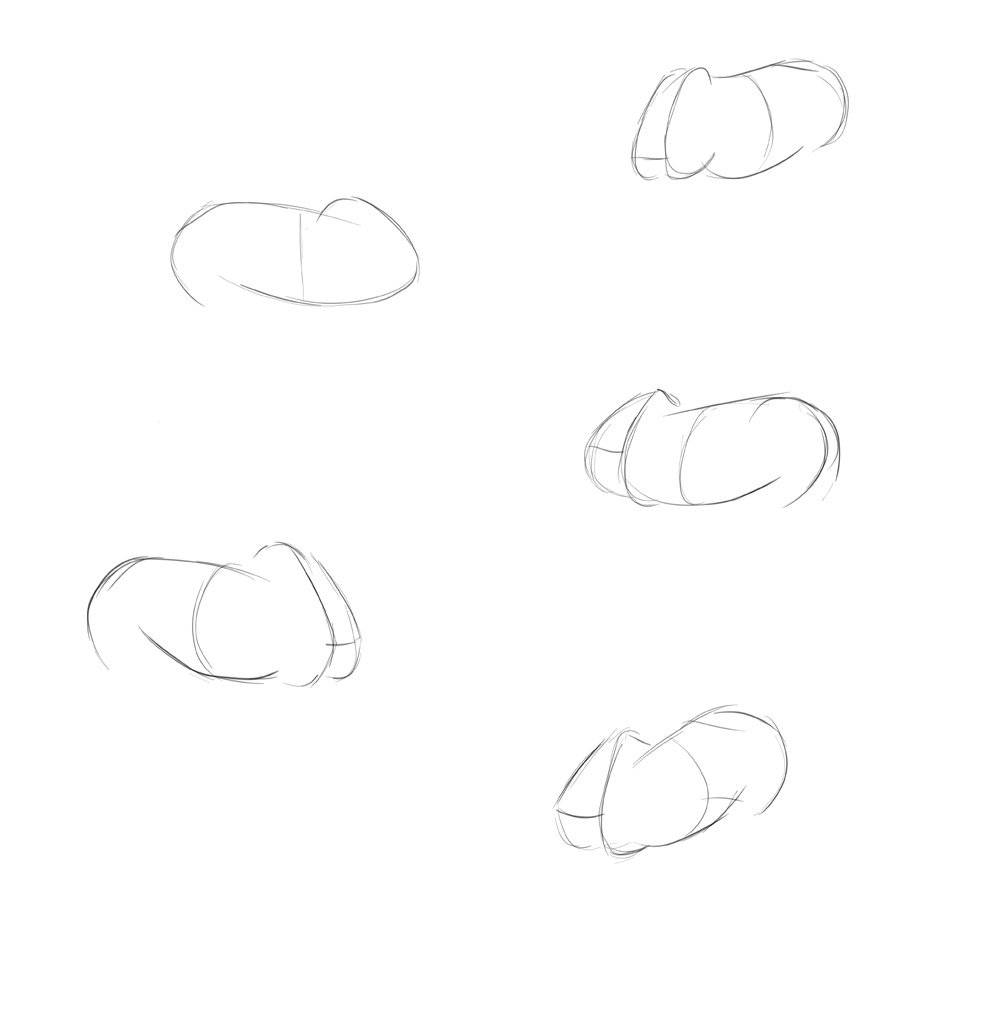
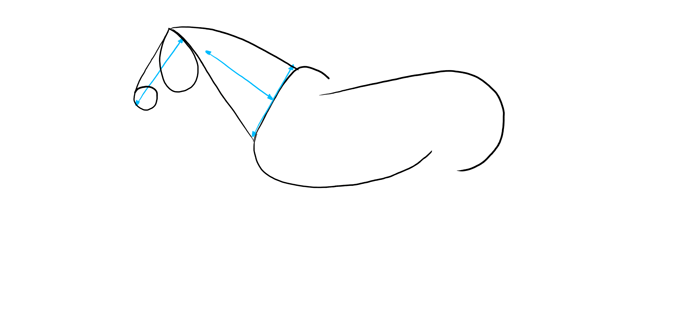
Now add the neck and head. This is the function where the proportions affair a lot. Roughly, the head should exist as long every bit the shoulders, and neck shouldn't be much longer than that. Nonetheless, this proportion is non so clear and information technology's good to practice it from references to grasp it.
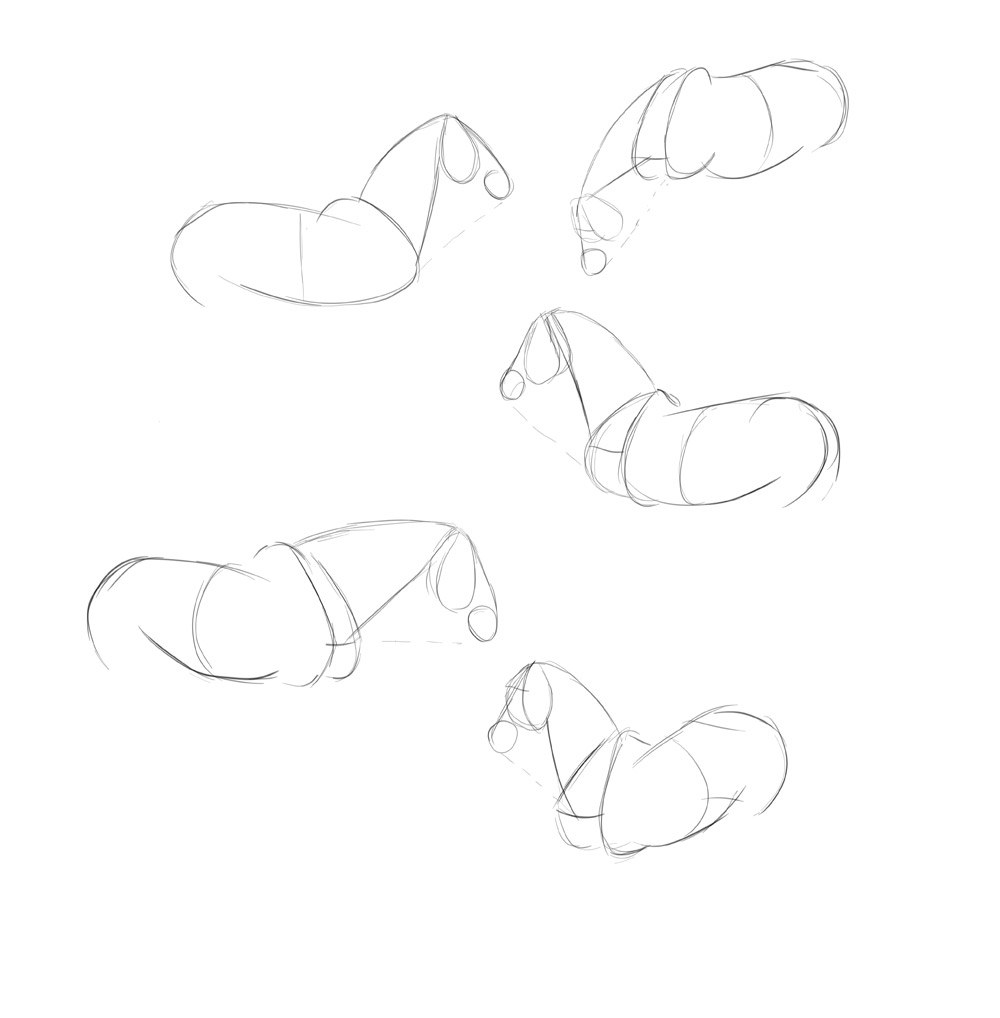
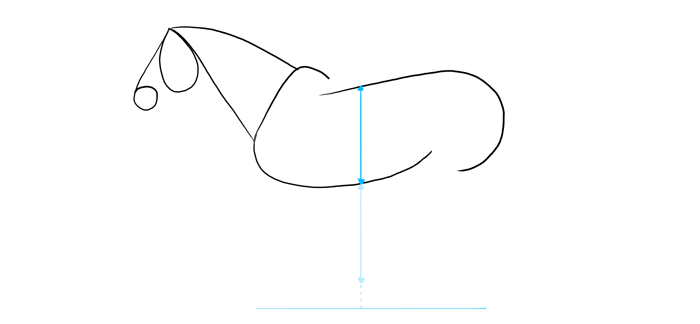
Time to find the final proportion: the distance to the basis. It depends on the breed, but in about cases this altitude is equal to the height of the main torso plus some more distance for the hooves.
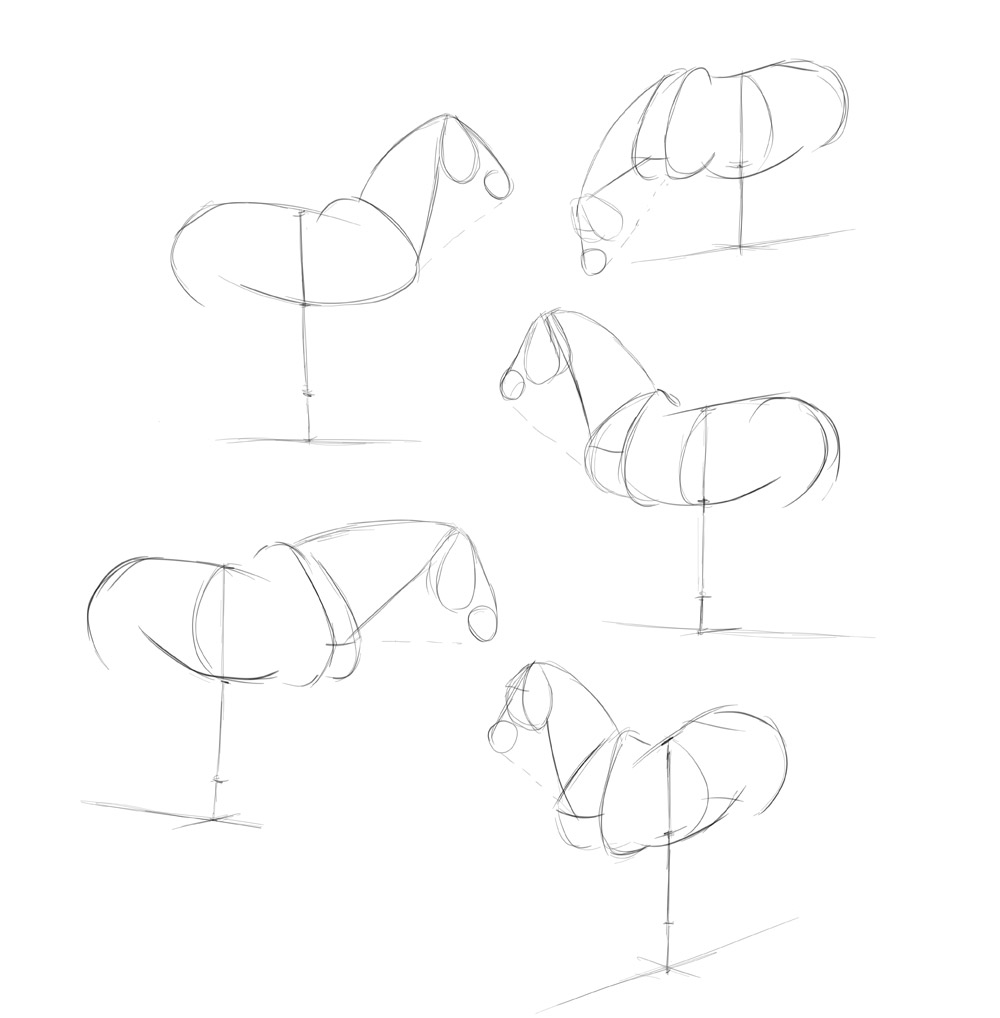
Permit'south add the legs now. You should be able to imagine the default position of them, with all the hooves on the ground. Then you lot can find a right position for the joints in move using this default position equally a reference.
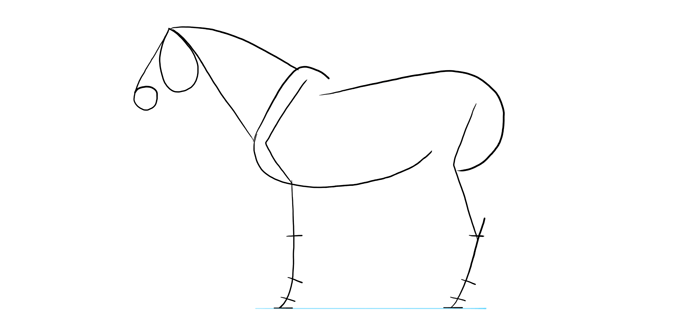
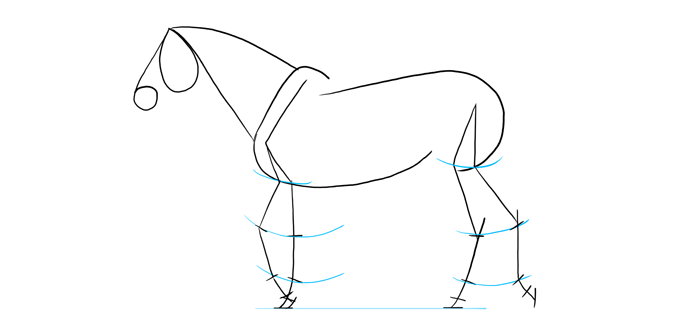
Start with simple lines for the legs…
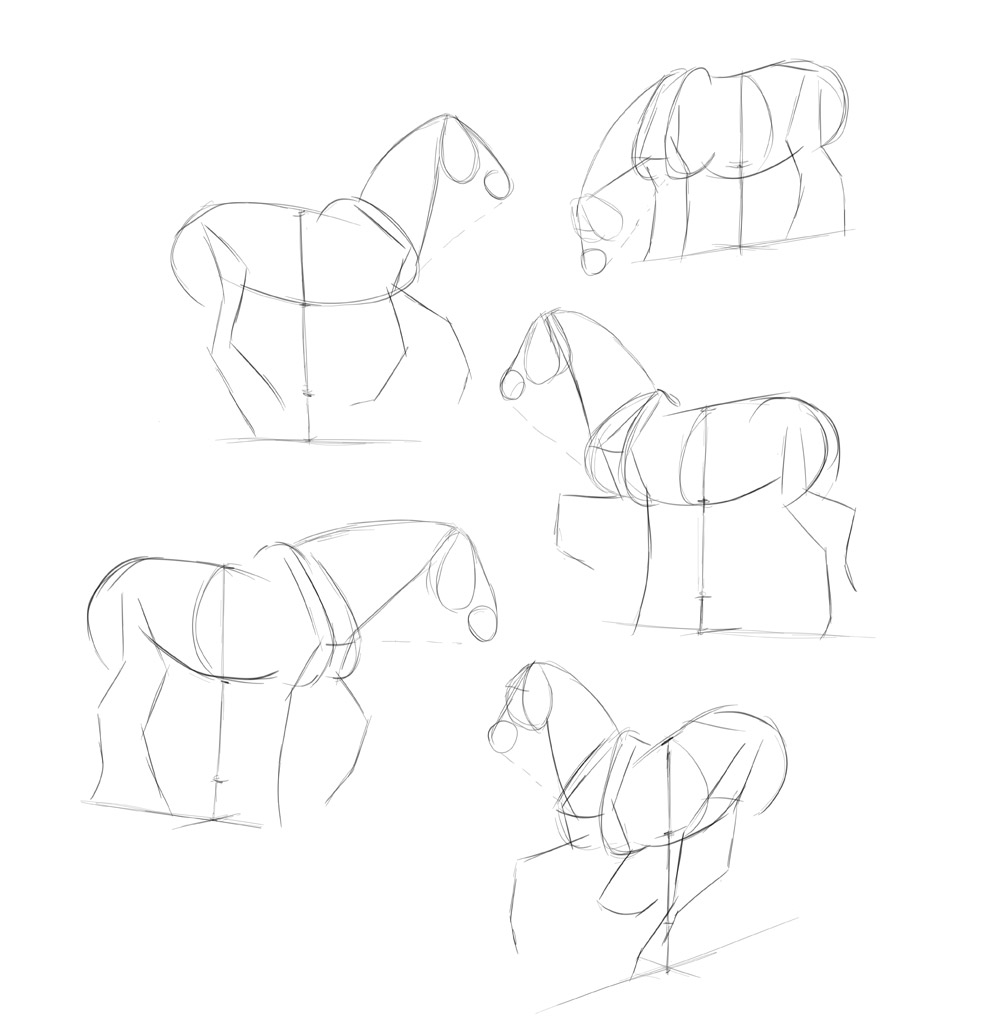
… then add the lines for the joints. Observe how you tin quickly describe the hooves in perspective without measuring anything.
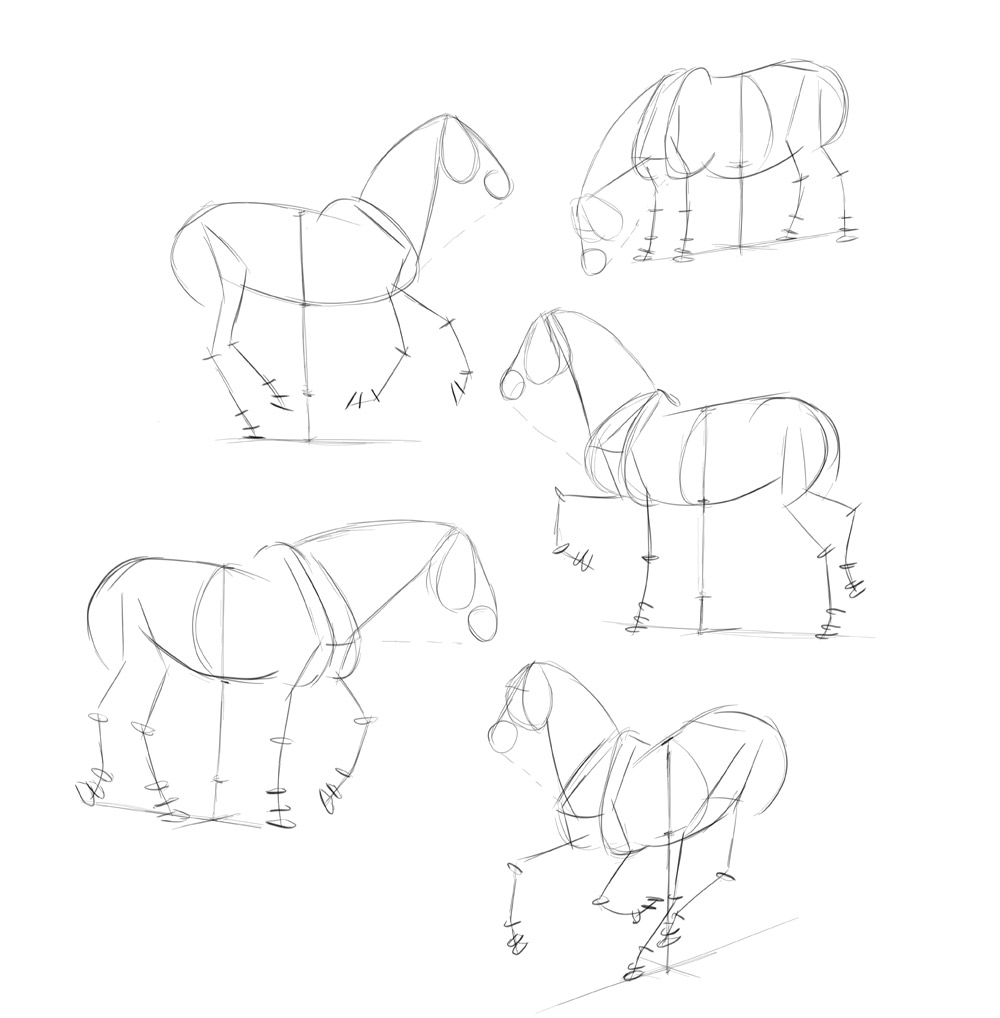
If your horse looks correct in this simplified form, you lot can now build on it, adding more elements. Kickoff you tin add width to the legs by sketching the shape of the joints.
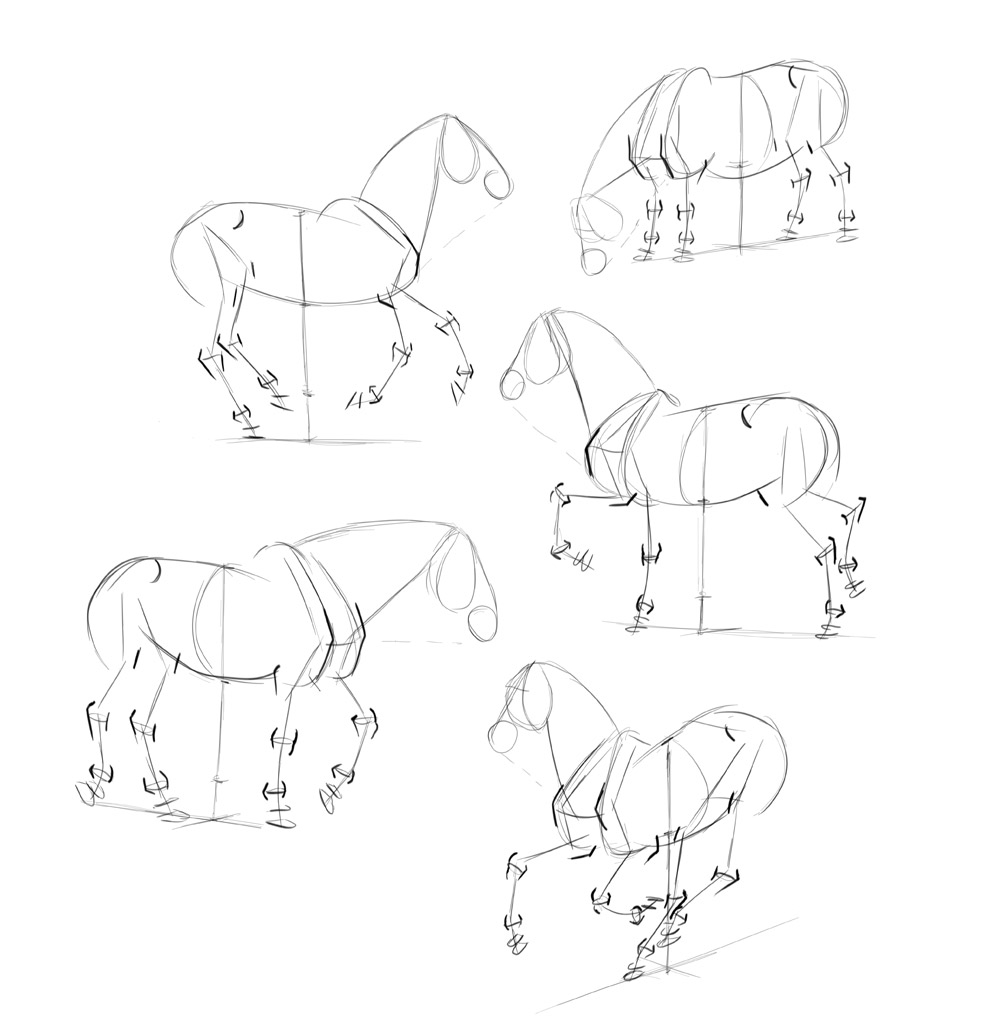
Then yous tin add together all the simple forms in the horse's body.
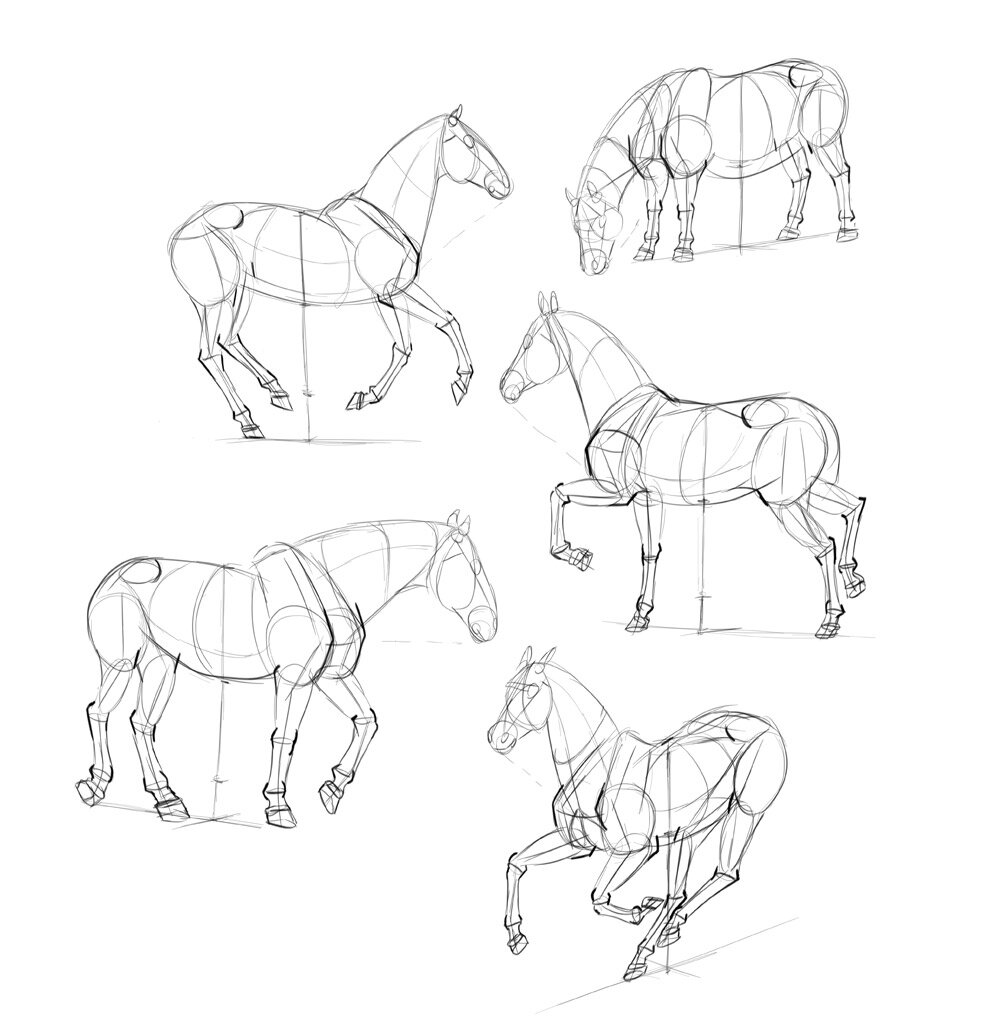
Once the body is properly constructed, y'all can add together the details: muscles, facial features, and mane with tail.
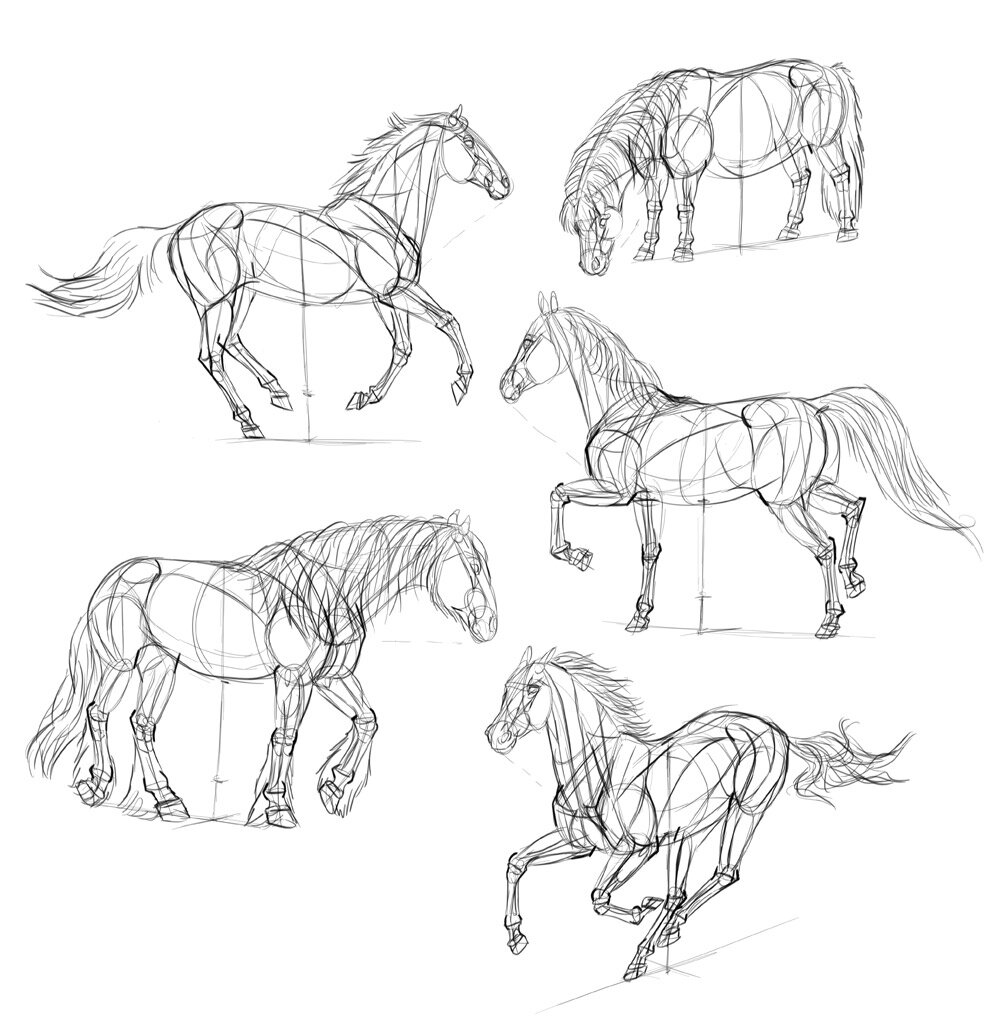
The sketch is done! Now you can create the actual cartoon using it as a base.
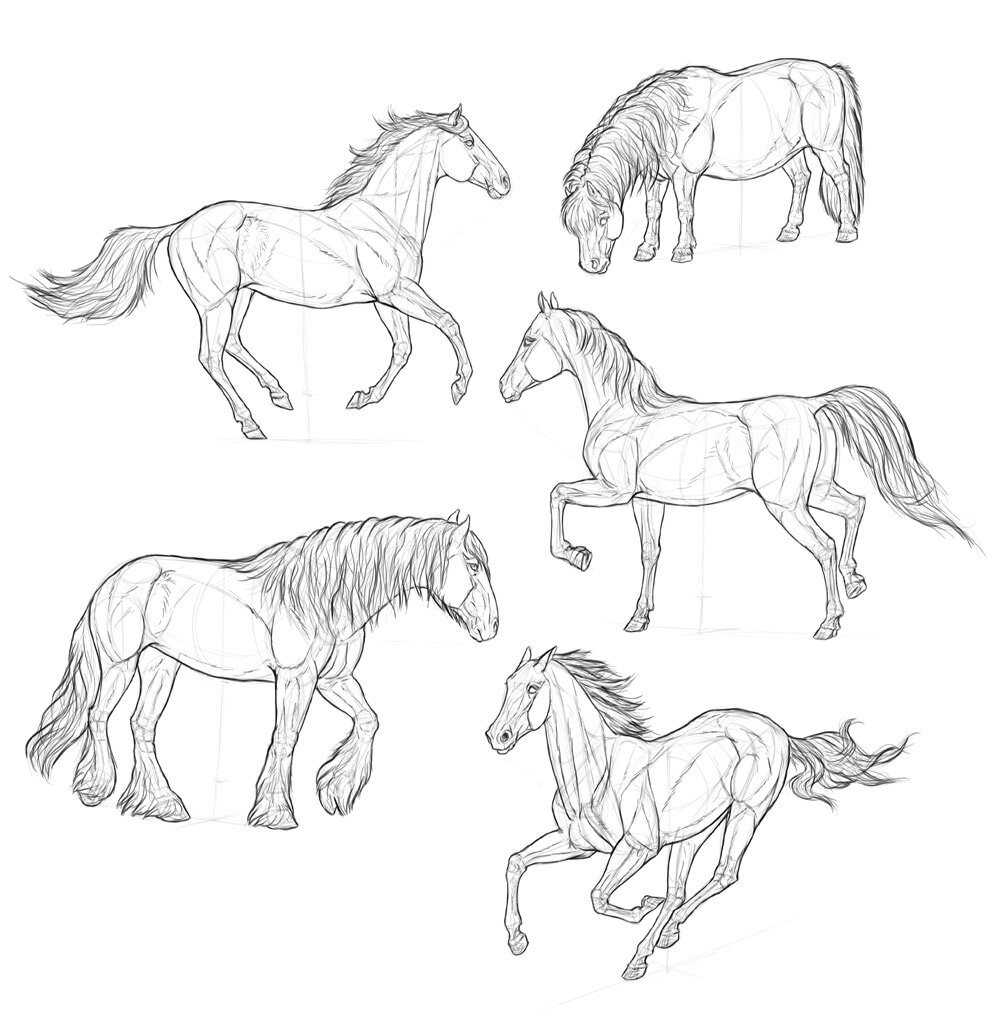
Time for the most fun part. Colour your equus caballus using the diagram with popular coats, or create your own fantastic colour combination.
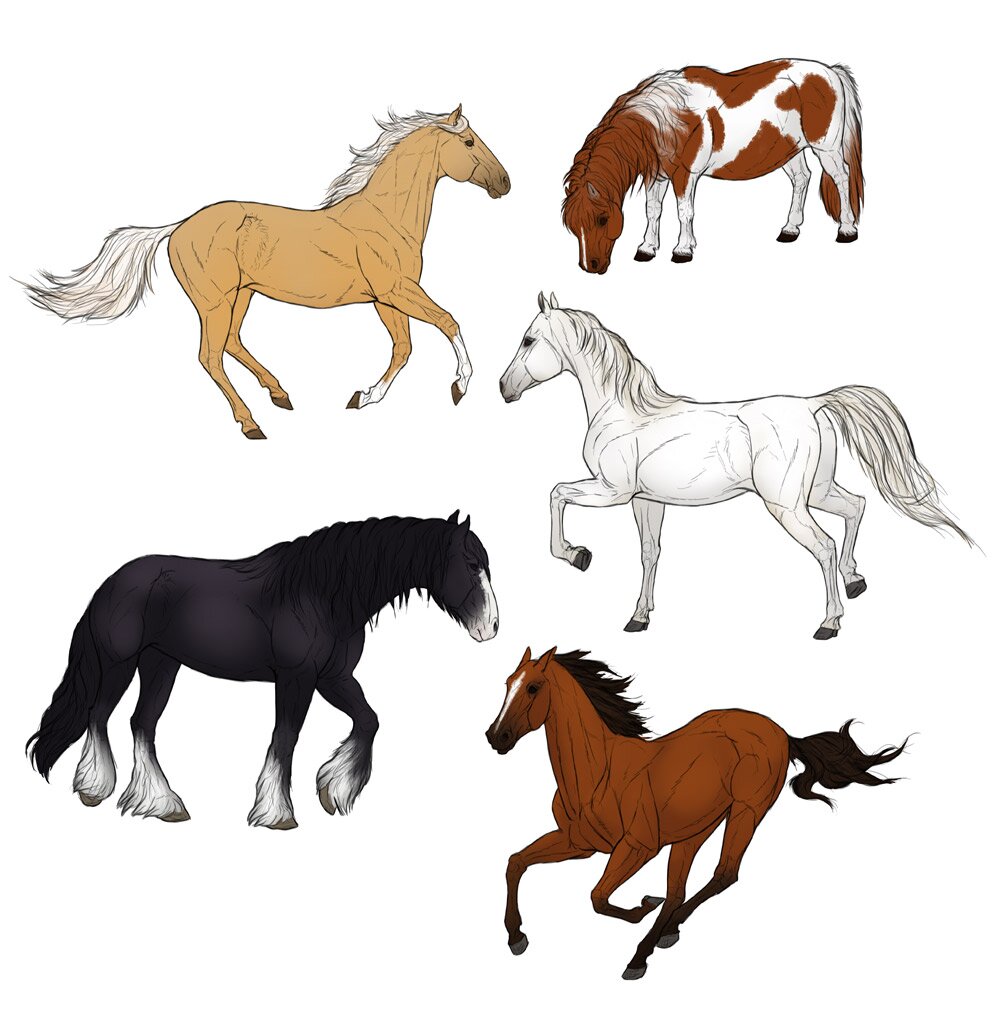
Y'all tin shade the horse to accentuate the 3D grade of its body. Employ this epitome as a reference, but adjust information technology to your own lighting conditions.
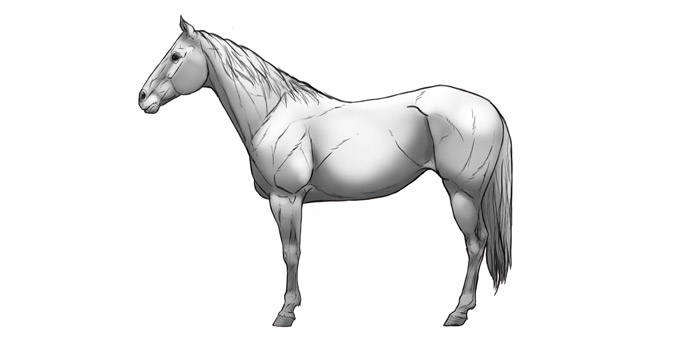
In SketchBook you tin can paint the shading on a separate layer…
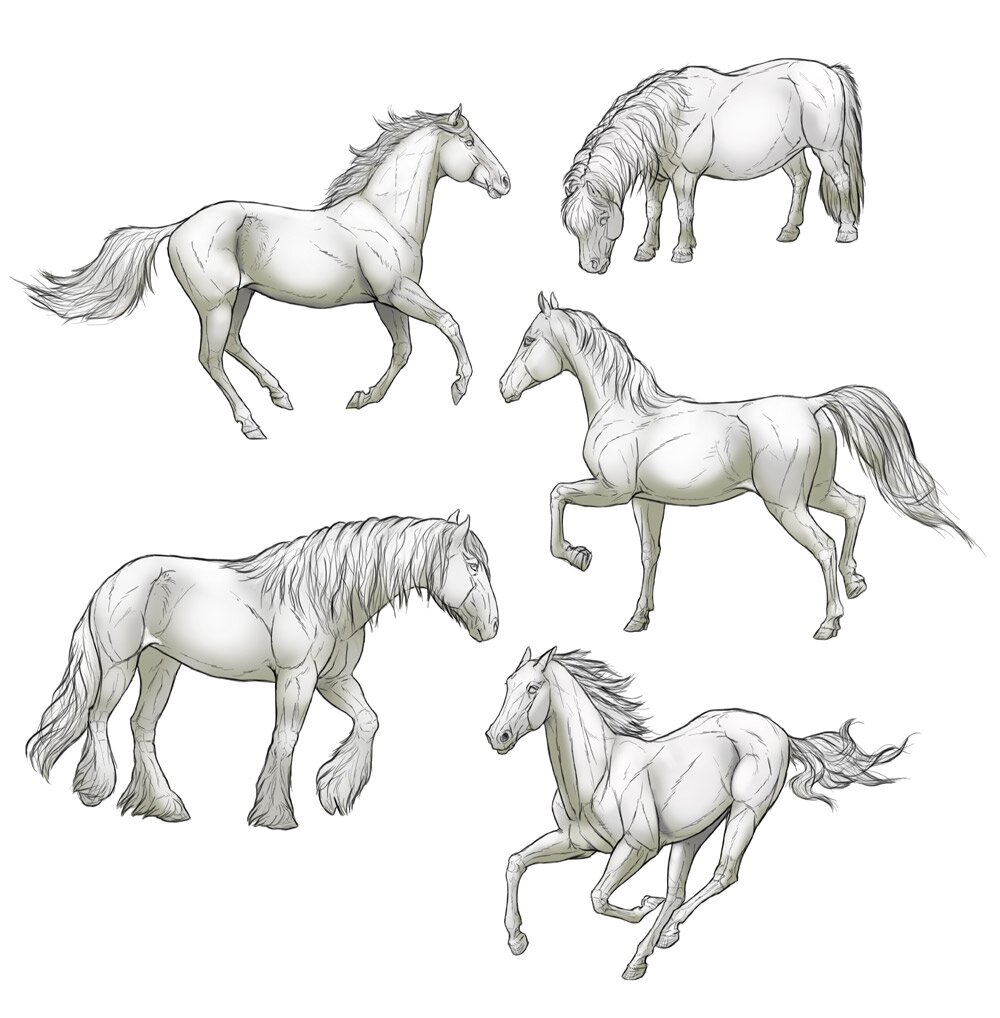
… and then change its manner to Multiply to affect the colors underneath.
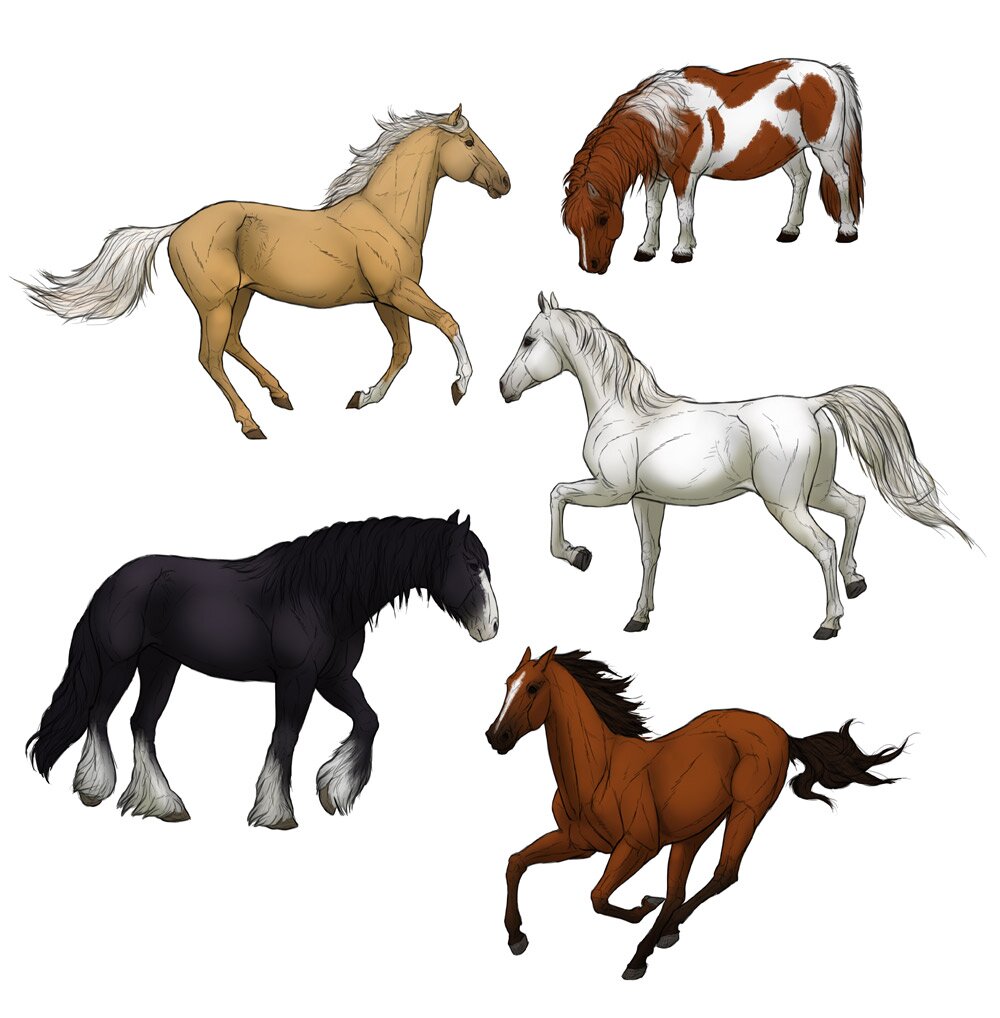
Finally, you can make the equus caballus hair shiny to make its form even clearer. Keep in mind this is stylization—horses are not so shiny in nature, especially when they're covered with warm fur.
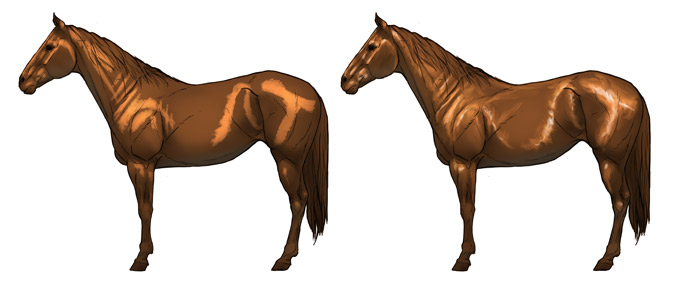
That's All!
But your task is not washed! To describe horses from imagination you lot demand to empathise the rhythm of their torso and make it intuitive for you. In society to do it you demand to draw a lot of horses: from photos, videos, and life. Use this tutorial every bit a set of tools to describe quickly and purposefully, but learn from real horses to translate my simplifications to the real life.

Source: https://monikazagrobelna.com/2019/09/15/sketchbook-original-how-to-draw-horses/
Posted by: carlsonmosion.blogspot.com
0 Response to "How To Draw A Horseshoe Crab"
Post a Comment